How the wheel of life taught me more about balance than anything else
Anja StankovićFebruary 4, 2026

February 4, 2026
The beginning of the year is a time when most people, almost automatically, decide to make big promises to themselves. Resolutions. New beginnings. Plans for how to become more disciplined, more successful, calmer, happier. For years, I entered every new year with the same question: what do I need to achieve this year to become a better version of myself? Behind that question, to be honest, there was often a need to regain control. Over myself. Over a life that frequently slipped out of my hands.
I have been going to psychotherapy for years, together with a group of women who share with me their everyday struggles and those that are harder to put into words. In that space, I learned that therapy is not a place for quick solutions, but for slow uncovering. The key theme we constantly return to, regardless of the reason we come, is the search for balance. Not a perfect, unattainable one, but a realistic one. A balance that is constantly questioned, lost, and rebuilt. One of the simpler, yet at the same time most effective exercises that I began practicing on my therapist’s advice is the wheel of life.
For those who have never encountered it, the wheel of life seems like a simple, almost naive therapeutic exercise. A circle divided into segments: work, health, family, friends, love, finances. When I drew it for the first time, I did not expect anything spectacular. And then that very simplicity caught me off guard. Because when I place all the important areas of my life into a single circle, it becomes impossible to hide behind explanations, obligations, or fatigue.
Drawing that circle, I saw my life from a bird’s eye view for the first time. Not as a list of tasks I had or had not completed, but as a whole in which some parts scream, while others barely exist. I realized that I was not living in balance, but in a constant transfer of energy from one area to another. And that I had been pushing some segments to the margins for years, convinced that I would return to them when there was time. To better understand what this is about, take a few minutes and follow the instructions below:
For at least a few minutes, the amount of time you need for this exercise, allow yourself to be honest. Trust me, it will pay off.
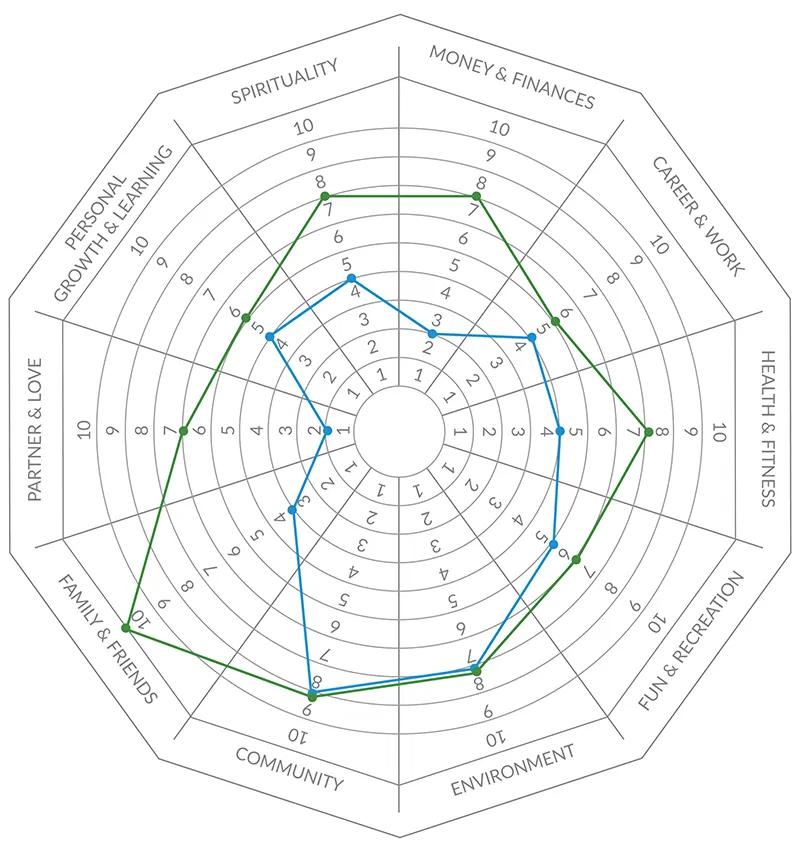
An important detail of the wheel is precisely this: do not strive for the number 10. Without room for growth, this exercise becomes just another piece of paper that consumes your time and energy. And perhaps an even more important lesson this exercise carries with it: balance and the perfection we constantly strive for are not friends.
The wheel of life did not ask me whether I was successful. It asked me where I was present and where I merely existed formally. While I was investing too much, to the point of exhaustion, in some parts of my life, I was maintaining others at a minimum, just enough to be able to say they existed. I did not notice that imbalance in the daily rush. It only became visible when I put everything in front of me, into a single drawing.
That is why this period stopped being a month of big decisions and loud promises for me. It became a time for evaluation. Instead of asking myself what I needed to achieve next, I began asking a much more important question: where should I direct my attention this year? That shift in focus brought relief and, surprisingly, real results. Remember, attention is not the same as pressure. It does not demand perfection, but presence.
Through working with the wheel of life, I learned that not all segments call for action. Some do not ask to be fixed, but to be noticed. To be given space without guilt that they are not better at the moment. Others, on the other hand, do not ask for change, but for honesty. An admission that they currently do not fulfill me, without the need to immediately know what to do with that realization.
The most important lesson I took from this process is that balance is not something that is achieved once and then maintained. Balance is a process. The wheel is constantly moving, changing shape, responding to the phases of life I am going through. What is stable today may be neglected tomorrow. And that is not a defeat, but a sign that I am moving, that I am changing.
In the end, the wheel of life did not teach me how to keep everything under control. It taught me how to be more honest with myself. And in a world that constantly demands more, faster, and better, that honesty has, for me, become the most valuable form of balance.
Find the printable template at the link.