Tarot has become a well-being ritual, here’s what the cards are really trying to tell us
Tina KovačićekMay 4, 2025

May 4, 2025
I must admit that I do not know much about tarot. Perhaps because of the mysticism that surrounds it, perhaps because of ignorance, you know how we tend to distance ourselves from what is unfamiliar, I have somehow avoided it in my life so far. With the growing attention it has been receiving, it seemed worth shuffling the cards and seeing what it is really about and what actually happens if we draw the Death card.
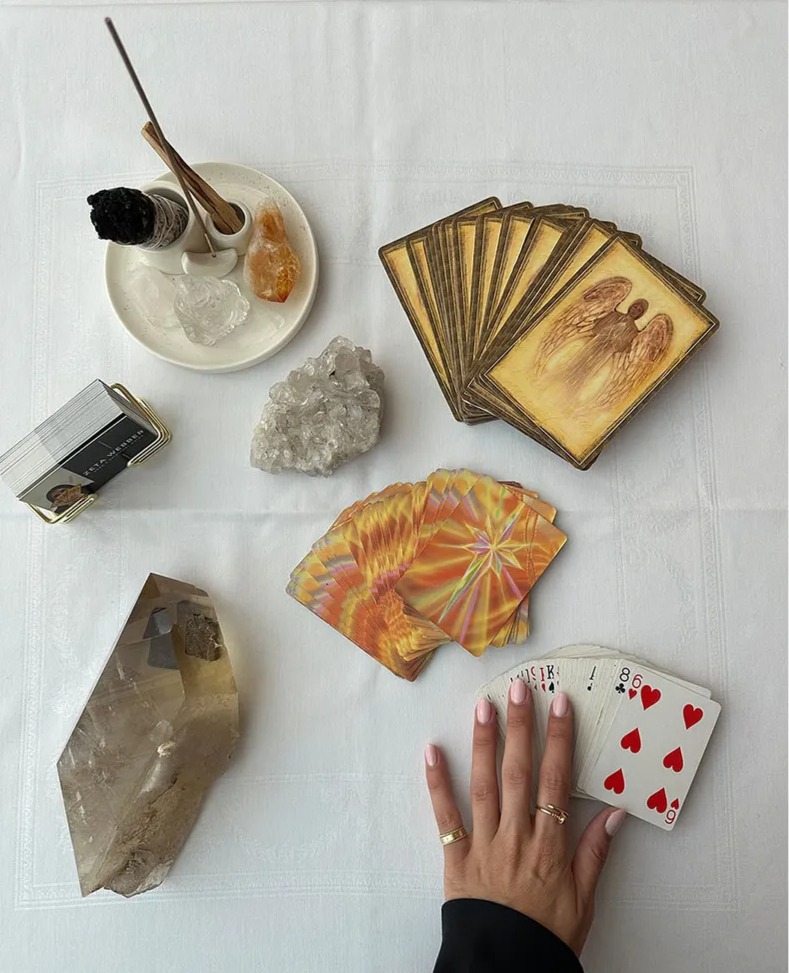
“Tarot is actually just an ordinary deck of cards,” Andrea Azenić, better known as Space Tiger, replies to my basic question. “I know, many people are surprised to hear that. That mysterious deck from horror films was originally just a social game for the aristocracy,” she explains with a smile. She adds a few historical curiosities: “The most famous preserved deck was made as a gift for Maria Visconti, and it was illustrated by Bonifacio Bembo, the very artist who created the figures of the Major Arcana. The Minor Arcana, historians say, were inspired by playing cards from the Mamluk Empire.” The deck was later reproduced throughout France, Germany, and other parts of Europe, but it was English esoteric societies that eventually wrapped it in a veil of mystery and occult meaning as we know it today. The history of tarot is truly fascinating and rich, although the cards themselves are not ancient. They date back to the fifteenth century, the period from which preserved examples exist.
Andrea has been working with tarot cards for 22 years, and the story began when, at the age of fifteen, she received as a gift the book Predicting the Future by Derek and Julia Parker, which offered an overview of the most popular divination techniques, including tarot cards. Looking at the Major Arcana in that deck, Andrea felt something familiar. “Images of biblical stories such as the Judgment card or the Tower of Babel, as well as archetypal figures like the Pope, the Empress, the Devil, or Death, felt magical. My path into tarot was really more like observing patterns between life situations and the images on the cards that would reveal some important event,” says Andrea, who at that point was already receiving her first calls from school friends asking her to read their cards. Can we all practice tarot, I thought to ask at that moment. Andrea assured me that we can, because there are various schools, courses, and books. “Information about meanings is available to everyone, and intuition and other, more developed senses are something we all have, we just need to unlock them,” she says, and truly immerse ourselves in the mysterious world of symbols. Okay, intuition, symbols. At that point tarot was already beginning to seem less incomprehensible to me, and I found myself increasingly drawn toward the group that turns to it more and more often in search of answers.
Although it has always been part of modern society, albeit among different social groups, tarot today has become easily accessible. Social media has definitely popularized it and stripped it of its taboo label. What has propelled it most into the spotlight, Andrea believes, are its values in modern psychology, art, and pop culture, as well as its eternal mystery. “There is something mysterious in those images, symbols, and representations, something that is difficult to explain.” While older generations can pass on wisdom and knowledge associated with tarot, younger generations are more open, though perhaps also somewhat lost. “I have noticed that many young people seek quick answers to questions about love, friendships, and even mental health. Perhaps tarot also attracts them because knowledge of the occult and the esoteric adds an edgy touch and does not belong to any established norm.”
Photo: Taylor Turner
In the uncertain times we live in, people more easily surrender to guidance beyond the visible world. Andrea has studied tarot for years and believes it has both psychological and mystical power. She also points out that even Jung recognized the value of tarot and astrology for the treatment and diagnosis of patients. “I think the contemporary Western world is still not ready to accept what it calls mysticism as a valuable tool that sometimes goes hand in hand with science and disciplines such as psychology. In any case, these symbols have a significant psychological and mystical role.” Part of the answer also lies in the decline of trust in traditional religions, while interest in spirituality and skepticism toward institutional authorities are on the rise. It seems that seeking answers through cards, about the future, the present, or past events, is becoming increasingly popular. According to the analytics platform Spate, searches in the United States for the terms “tarot cards” and “how to read tarot cards” increased by more than 30 percent during the pandemic. Another study predicts that the tarot and oracle industry will reach a value of 93 million dollars by 2027.
As interest in tarot and oracle cards grows, decks are multiplying and evolving, each carrying the unique imprint of the time in which it was created. Artists from different eras have breathed new life into tarot through their own aesthetics. For example, Leonora Carrington presented her mystical and surreal vision of the Major Arcana in 1955, while Salvador Dalí created a lavish and theatrical deck in the 1970s, inspired by an unfinished collaboration for a James Bond film that opened the door to the world of tarot for him. Today’s scene offers a wide range of decks that reflect identities and communities around the world. Dust II Onyx by Courtney Alexander empowers narratives of the Black diaspora, The Gay Marseille Tarot by Charlie Claire Burgess brings a queer perspective, while Secrets of Paradise Tarot by Leticia Ferrer Rivera and Laura Bello connects tarot with the spiritualities of Latin America and the Caribbean. There are also decks that celebrate the body and sexuality, such as Goddess of Love Tarot by Gabriela Herstik. “When artists shape tarot through their own eyes, it becomes a tool of real power,” Herstik emphasizes for Vogue. “My deck is dedicated to those who connect with their sensuality, emotions, and intuition.”
The world of high fashion is not far behind either. Dior has presented limited edition tarot scarves, while Gucci, under the creative direction of Alessandro Michele, has used tarot symbols as a recurring motif. Chanel incorporated tarot inspiration into its makeup line “Clairvoyance,” and Hermès into luxurious silk scarves featuring card details.
Photo: Ava Dillon
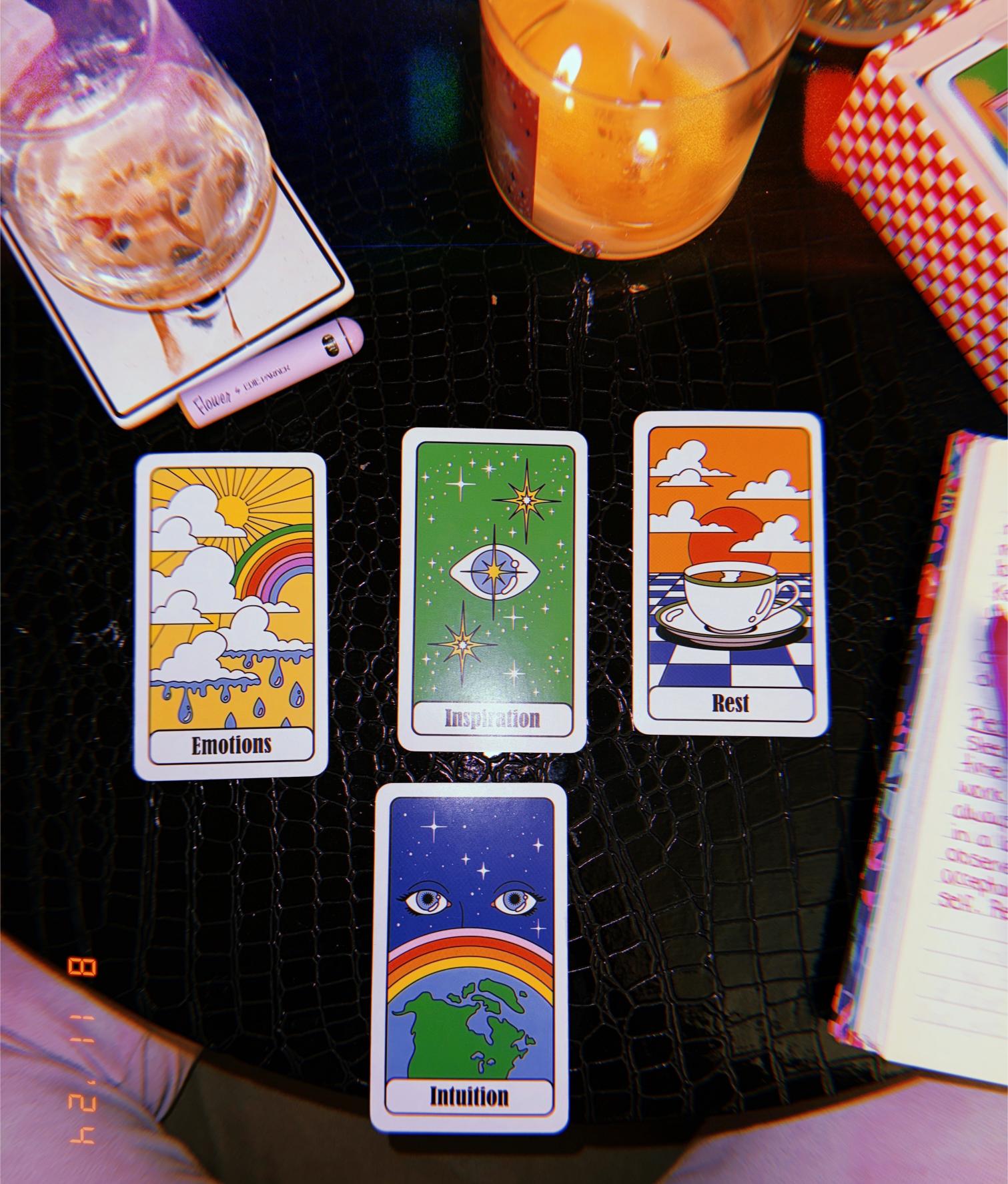
How much someone sees in tarot cards depends on their experience, abilities, and knowledge, Andrea tells me, emphasizing that symbols reign supreme here. Cards are read through spreads, for example a simple three card layout: Situation, Advice, Outcome. There are also more complex ones, such as the Celtic Cross, which includes up to fourteen cards. “In my view, tarot does not predict a concrete future, but reveals patterns, circumstances, and the energy around us, and how we act on those insights depends solely on our free will.” Some cards gravitate toward the negative spectrum of human experience, such as “the Devil, which shows addiction and weakness, the Ten of Wands, which represents exhaustion and lack of will, or the Tower, which points to sudden events that may not be pleasant, but even those cards carry wisdom within them, a warning to be mindful of how we approach a situation or a relationship,” Andrea explains, at which point I blurt out a question about the Death card and Andrea laughs. “One of the ‘scary’ cards, but no, it does not signify physical death, but life transformation, such as ending a contract, your cactus wilting, or the time to change your diet. Death actually represents a transformation that can be difficult for us, but it signals the end of something and the beginning of something new. Sometimes even good cards can be bad, like the Three of Cups, which often appears in readings as a love triangle. Although it is a very positive card, I doubt people are thrilled when there is a third person involved romantically. So everything depends on the context of the question.”
Tarot, astrology, and runes are three different systems of symbolic interpretation, each with its own tools and traditions. Andrea patiently answers this decisive question of what to reach for when in need. “Tarot uses cards for personal insight and spiritual guidance, astrology analyzes planetary positions to understand life patterns, while runes, based on Nordic tradition, are used for decision making and intuitive guidance. Although they share a symbolic approach, these are completely different systems, like the Chinese I Ching.”
All seventy eight cards tell us something, above all they depict human experience. The Minor Arcana, fifty six cards, represent everyday situations, while the Major Arcana, twenty two cards, depict major life events. At least that is how prominent contemporary tarot thinkers such as Alejandro Jodorowsky, Rachel Pollack, and Camelia Elias would agree. “Tarot has personally helped me understand some difficult and painful life moments more deeply, such as death and loss. It has always been a gentle and quiet guide for me, one that did not give ready made answers but showed direction. From my own experience, and from conversations with many people, including therapists who increasingly recognize its value, I can say that it is an extremely useful tool for inner work and self understanding,” Andrea believes, also pointing out that it can be quite humorous. For some, it is a lighthearted pastime over coffee, while others take it very seriously. “For me, it is certainly a tool for self knowledge, guidance, and humor when life becomes a little confusing.”
Although tarot still carries a degree of mysticism, many people today do not see it as fortune telling, but as a means of self exploration and personal growth. “The cards help us bypass the rational mind and touch deeper layers of our own intuition,” Herstik explains for Vogue. “They act as a bridge to the subconscious and help us see ourselves and the world around us more clearly.”