Social wellness is the travel trend quietly taking over 2026
Tina KovačićekJanuary 23, 2026

January 23, 2026
The ancient Greeks once loved exchanging conversations while relaxing in public baths. We, modern people a few thousand years later, have steered wellness toward solitary experiences. Calming spa rooms, personal training sessions, meditation in isolation, all of it leads us inward, but through a very lonely process. Yet lately, a quiet, or rather a very social revolution has been taking place. Social wellness is becoming one of the most exciting lifestyle trends of today. Forecasts say that this year it will also become one of the biggest trends among travelers. This means that when you arrive in a new city, you will seek out local spas, baths, and saunas that bring you closer to locals and to the culture itself. If you may have previously traveled for individual retreats, this social trend tells us something else: being well is not something we do alone, but together.
Quite recently, while writing about the return of urban bathhouses, we are indeed circling back to the ancient Greeks, I realized that the time has come for socializing in spaces that once felt unimaginable as places to go out, where you would take a friend and catch up on what is happening on the social scene. This is why Gen Z these days increasingly chooses saunas and public baths as places to go out and spend time together, alongside a growing consumption of non-alcoholic drinks, having realized that alcohol is not exactly a great addition to life. Millennials, meanwhile, are using saunas or public baths as places they no longer want to visit alone for their own well-being, but to share that experience with friends.
To this, I would add Zagreb’s KHOLO, a party concept held midweek, always on Wednesdays, conceived as a reason to dance freely and connect. “In a world of immense separation, conscious gathering with intention becomes medicine for the soul. We no longer need top-down leaders, we need each other. Spaces of equality, authenticity, and wholeness,” Dejana Koprivc tells me. She is the organizer of KHOLO and a yoga teacher whose retreat journeys, held in Croatia as well as in Bali and other countries, are exceptionally well attended. “They are conceived as experiences of collective healing, because within community we learn the most about ourselves. Masks fall away. The heart opens. Humanity grows. Every circle, meeting, and act of sharing builds that feeling of belonging and acceptance. For me, these are spaces of contemporary rituals, deeply inscribed in our genes, which we may have forgotten, but the body remembers.”
And more and more people are seeking this. “People no longer want to be alone, even in healing,” say leading therapists and wellness educators. After years of pandemic withdrawal, isolation, and digital fatigue, the need for physical closeness, touch, laughter, and healing in community is becoming ever more pronounced.
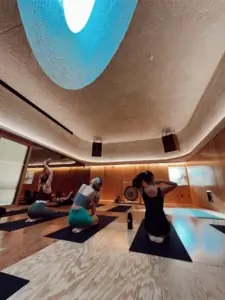
Photo: Emma Cancilla
Beyond quite literally bringing us back to one another, social wellness offers a sense of belonging that has become just as important as a yoga pose or a spirulina smoothie. In a world where mental health is finally being placed in focus, we no longer want to be alone with our thoughts, but to share them. Experiences such as sharing circles, group meditations, sound healing sessions, and collective rituals are gaining momentum. Remedy Place, for example, represents a pioneering social wellness club concept on the American market, one that blends self-care with social interaction. “I wanted to create a space that enables physical and emotional healing through shared experiences,” says Dr. Jonathan Leary, a chiropractor and alternative medicine specialist who recognized the importance of this approach years ago, when he first launched it. His clubs, now found across the United States, offer a wide range of treatments such as infrared saunas, cryotherapy, hyperbaric chambers, acupuncture, massages, and group ice baths, often enjoyed in the company of friends or partners. Design also plays a key role; the interiors are carefully conceived to encourage relaxation and social interaction. For instance, ice bath and sauna treatment rooms are designed for group use, allowing guests to share experiences and create collective memories. This approach not only promotes physical health, but also emotional well-being through shared activities.

Rosewood hotels / Asaya Spa
In cities around the world, a new generation of bathhouses and spa centers is abandoning the idea of private relaxation and becoming social hubs for connection and shared experience. Spaces are designed for conversation, memberships create a club-like atmosphere, and holistic wellness programs combine fitness, saunas, and dedicated areas for socializing. Cascada in Portland, for example, brings together several floors of wellness facilities: underground rooms for quiet bathing, a greenhouse with an indoor pool and shared outdoor space, and, with the addition of a new restaurant and bar in 2026, further emphasizes the social function of the venue. The membership model allows regular visitors and hotel guests using the wellness facilities to socialize, turning the space into a true neighborhood hub rather than just a spa.
Rosewood Asaya also operates as a social wellness club across several global destinations, including Doha and London at The Chancery Rosewood. Here, baths, saunas, pools, and wellness programs are not designed solely for relaxation, but to encourage interaction, togetherness, and social connection, confirming the trend for 2026: bathhouses and spa centers are no longer private retreats, but new urban meeting places.
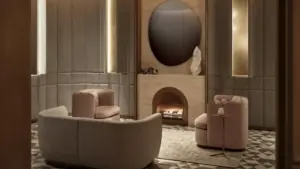
Rosewood hotels / Asaya Spa
Brands, wellness centers, and hotels are quick to recognize this shift. More and more programs now include shared activities, from community sauna nights to group evenings of silence. Even the aesthetics of wellness spaces are changing: they resemble “zen cells” less and “living rooms everyone wants to be in” more. Social wellness encompasses all forms of self-care through connection with others rather than through isolation. It marks a shift from individual routines toward shared experiences that nourish both body and spirit, through togetherness, safety, and support. And it increasingly feels less like a trend and more like a transformation in how we live, connect, and heal.
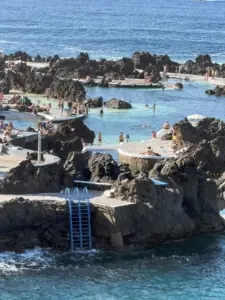
Photo: Danielle Hammond
Shared activities that strengthen body and spirit
Group meditations, guided relaxation, and sound healing sessions are becoming increasingly popular, with sound baths experienced collectively, enhancing the sense of togetherness. There are also sharing circles, spaces where participants share thoughts and feelings without fear of judgment. Within retreat programs, combinations of yoga with a focus on connection are becoming more common, as are breathwork rituals practiced in pairs or groups.
SuperSoul yoga, led by Dejana Koprivc, often takes participants on longer and shorter trips, thoughtfully planned around shared activities such as cacao ceremonies, sound healing, nature walks, and, of course, the practice of yoga.
Nina Kraljić, a musician, is known for her dedication to sound therapy and sound baths, which she regularly holds across Croatia. It is a gentle yet very powerful method carried out using singing bowls, gongs, and other healing instruments, each with its own frequency spectrum corresponding to specific areas of the body..
Body & Mind Studio, as part of its regular fitness program, also offers breathing programs that teach you how to breathe properly.
Spa and sauna experiences with a social component
An increasingly sought-after form of social wellness includes experiences that nurture the body while creating space for togetherness. Community sauna nights, guided evenings in the sauna accompanied by music, essential oils, and silence, are becoming rituals of connection through warmth and presence. Shared ice baths are also popular, often paired with guided meditation, breathwork, or music, transforming what might be a challenge into a group experience of empowerment.
The Transformation School of Hrvoje Zalukar regularly organizes cold-water immersions in the Dobra River..
Danijel Dubičanec, a yoga instructor, often invites participants to winter swimming in Gorski Kotar.
Thermal spas in the region often design special sauna programs as part of their offerings, combining scents, meditation, and massages.
Rituals and workshops
Cacao ceremonies, circle dances, and dance therapy create a safe space for expression and emotional release through movement. There are also art workshops with a therapeutic approach; collective painting, music, or writing become tools through which participants connect, express themselves, and heal. A special role is played by release rituals and moon circles, guided ceremonies that use the symbolism of natural cycles as a framework for personal and collective growth. Forest bathing, which we have written about before, is also one of the increasingly practiced ways of returning to oneself.
The Slovenian Forest Therapy Association was formed quite recently with the idea of gathering a community around one of the most popular nature-based healing therapies. With expert guides, Forest Therapy organizes walks in the forest.
Move With Kaya offers insight into all the ways dance can be used as a therapeutic tool for release.
CeKaTe regularly hosts writing workshops and creative expression sessions.
Studio Juha offers a wide program of workshops and courses in working with ceramics and porcelain, from making to painting, with the group-based approach being particularly creative.