I tried introspection cards, the self-reflection tool everyone is talking about
Introspection cards are one of those self-care tools that can help you get to know yourself better, as well as the people around you.
by Tina LončarJanuary 10, 2026


Introspection cards are one of those self-care tools that can help you get to know yourself better, as well as the people around you.
by Tina LončarJanuary 10, 2026
Even though it was at least a decade ago, I still vividly remember that week when our little circle of girlfriends gathered at a friend’s apartment to cook together. We were excited about collectively diving into culinary experiments, but what truly thrilled us was hidden somewhere else entirely, far from thinly sliced zucchini, hummus, and homemade gyoza: a deck of colorful tarot cards our host had ordered online.
At the time, tarot was a complete mystery to me. I had no idea what to expect. Would it be a fun distraction, like reading horoscopes in the daily paper, or something more serious, like poking around a destiny already written in the stars? Would it tell me when I’d meet a tall, dark stranger, how many children I’d have, or when I’d finally renovate my apartment? And how was I supposed to carry all of those life “instructions” once I knew them?
I had a thousand questions, and very few answers.
Of course, the cards did not tell me that I would meet Brad Pitt at the post office, nor that I would fall off my bike one November evening on my way home from work. The reason I remember that week so vividly is because it feels like we had never connected more meaningfully or more deeply. The cards gently guided our dilemmas toward answers that were finally beginning to take shape, but more than that, they gave us permission to open up to one another, to truly listen, to talk about everything weighing on us, without calculation or restraint, and to receive support and understanding we perhaps had not even known we needed.
From that day on, tarot cards became my favorite tool for connection, with others, but first and foremost with myself. A quiet guide into introspection, something that brings calm, shows me doors where I thought there were none, and, most importantly, gives me the space to tell my own story.
Apologies to self-proclaimed witches and occultists, but I have never perceived tarot as something mystical, fatalistic, or obscure. Quite the opposite. Instead of a tool for predicting the future, I found in the Major and Minor Arcana an opportunity to explain to myself who I am right now, what truly matters to me, and what is actually troubling me. To understand myself better, exactly as I am in this moment
Ever since humanity existed, people have tried to understand themselves and the world around them. Tarot, which originated as a card game for the aristocracy and only began to be used for divination in the 18th century, is just one of many ways we search for comfort in the middle of life’s shipwrecks, and for direction when the path ahead becomes blurred.
As long as we understand that self-care practices cannot replace psychotherapy (when it is needed), what truly matters is finding the one that resonates with us the most. If something makes us feel better and gives us what we need, it really does not matter whether we call it journaling, meditation, yoga, tarot reading, or staring at the stars. And it certainly does not matter what others think about it.
The self-care industry has recently become something of a buffet, and beautifully illustrated tarot decks are no longer the only cards we turn to when dark thoughts start swirling above our heads. Introspection cards (sometimes also called reflection cards or mindfulness cards) are everywhere right now, and their popularity is steadily growing.
They come in countless variations: from decks offering instructions for mindful living in the present moment (sometimes we simply need to be reminded to breathe), to cards printed with mood-lifting affirmations, to those encouraging small activities to distract us from anxious thoughts, and even versions that present a single question or one word to help us look at a problem from a different angle.
They all serve the same purpose: to act as tools for grounding, chasing away heavy thoughts, and getting to know ourselves better (as well as those around us).

No matter which type of introspection cards you use, the principle is more or less the same. You do not have to darken the room and drip 17th-century candle wax over yourself while wearing a long black lace dress (though you can, if you feel like it).
I prefer to sit somewhere quiet, without distractions, in silence, or perhaps with soft instrumental music playing in the background. After a few deep breaths, once I am sure my thoughts have settled, I shuffle the cards and set an intention. I ask myself what I want to receive from the cards spread out on the table, and begin to reflect on whatever has been weighing on me lately, occupying my mind, or making me so anxious that it becomes difficult to focus on everyday tasks.
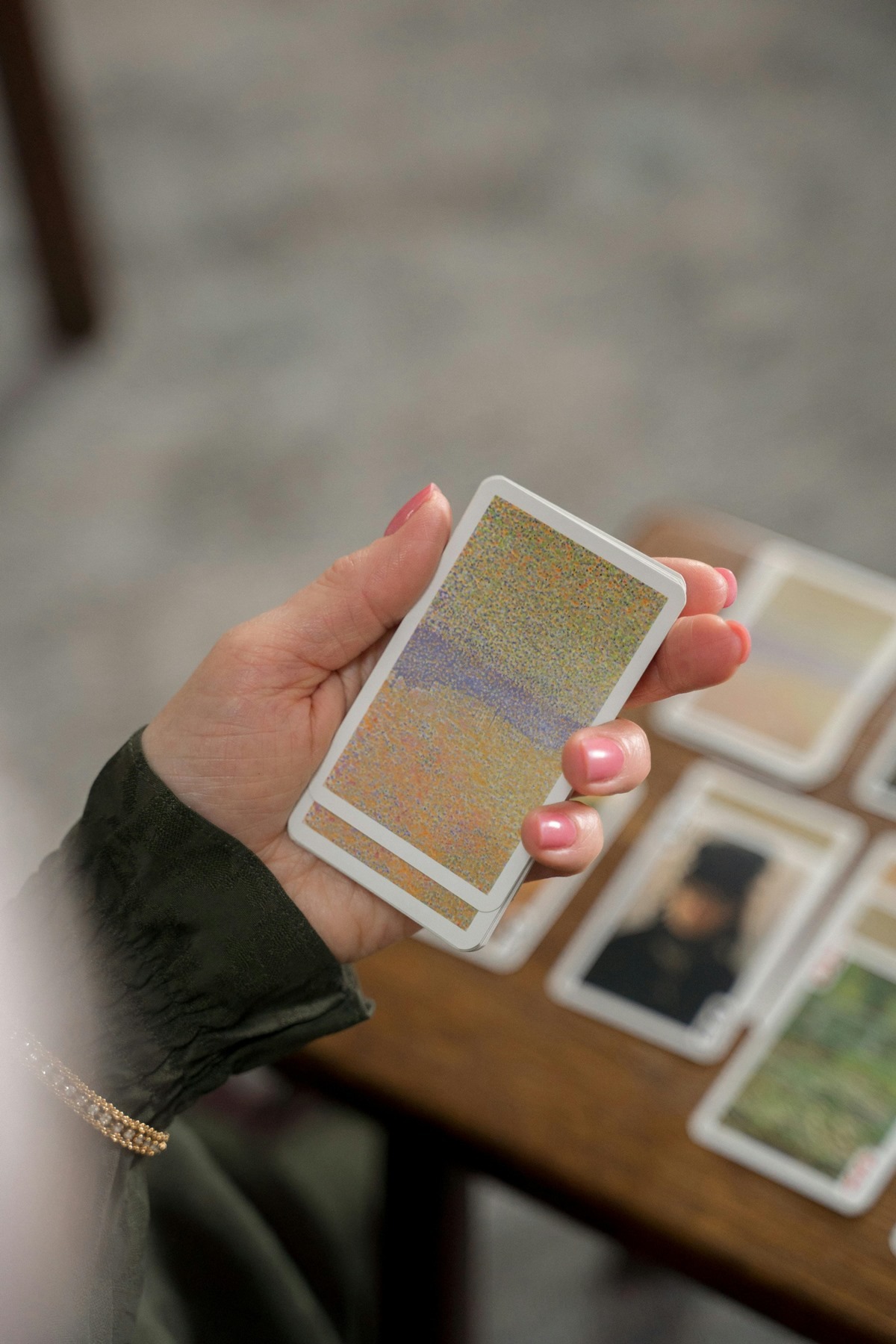
When I am clear about what I want to explore, I ask my question. Most guides for using introspection cards will suggest choosing one card intuitively from the deck. I usually pick the one whose back looks the prettiest to me in that moment. But you can choose several, however many feels right. The only thing that truly matters is listening to yourself and trusting your intuition.
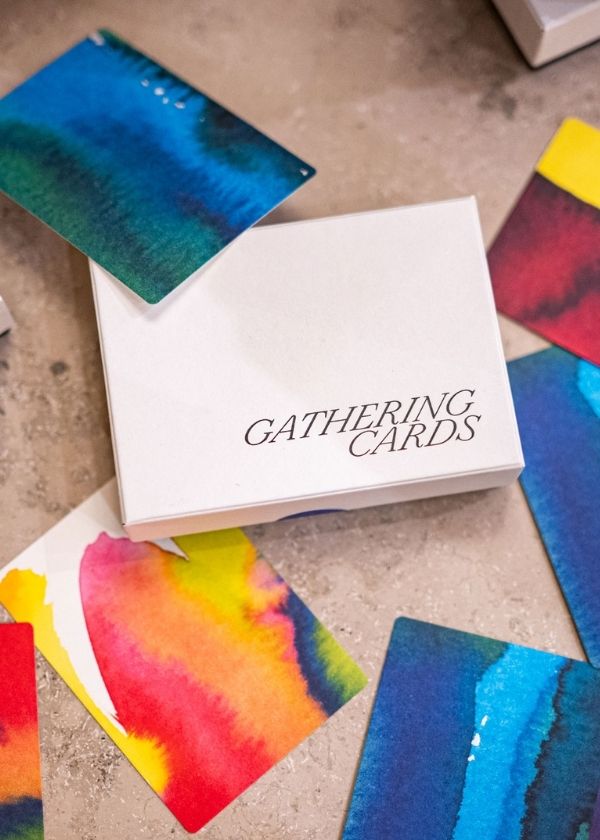
The introspection cards I used are the Gathering Cards by Tatjana Grozdanić Begović, an architect who launched them in mid-December last year as a tool for reflection, creative thinking, and for connecting with others through open conversation and shared experiences or insights. Each card features just one word or a very short sentence, and the back of every card is painted in soft, visually inviting watercolor tones.

I used them for the first time on a day when my anxiety was completely out of control. Compared to my thoughts, American disaster blockbusters felt like wholesome documentaries about ducklings and kittens. My mind had been melting into endless darkness all day long, and not a single thought that crossed it was even remotely bright.
I knew exactly what was bothering me: I had taken events that had not even happened yet and turned them into the worst possible scenarios. It felt like the perfect moment to ask the cards what they “thought” about it all.
I pulled a card twice, repeating the same question like a mantra, and both times I received the same message. It was the kind of answer you already know is true, but struggle to hear when anxiety takes over. Like someone gently reminding you to breathe, the card reminded me that my anxiety was built on pure invention, that nothing gnawing at me and weighing me down was actually real.
But beyond nudging me to look at doors I had been actively avoiding, reflecting on my question pushed me to sit with the problem instead of running from it. I tried to see it more rationally, which pulled the curtains open just a crack and let a thin ray of light into my thoughts.
Much like tarot, I was able to sit alone with myself and sink into my own mind, guided by a single, randomly chosen word. That word is not magical, of course, but if you are open enough, willing enough, it can be more than enough to help you tell yourself your own story, or consider an option that had never occurred to you before.
These cards are something like a crutch you reach for when your leg hurts, a small support when things feel heavy, offering just enough stability and hope to remind you that not everything is as dark as it seems. And in a world where we are constantly available, except perhaps when we sleep, simply sitting still, looking at the soft colors spreading across the backs of the cards, and thinking, feels like a quiet kind of blessing.

Although I have not yet tried introspection cards in the company of friends, I am quite certain they can also be a wonderful tool for connection, honest conversations, and sharing experiences. Life often feels lighter when we allow ourselves to voice what is weighing on us. More often than not, we realise that others carry the same quiet struggles, and that there is something to be learned from their perspectives, too.
And perhaps it is best not to wait until the darkest thoughts start to spiral before reaching for the deck. One card in the morning, paired with a few deep breaths, could be a simple yet powerful way to give the day a softer, brighter tone from the very beginning.