
In front of my grandfather’s house in Sjenokosi stood a hundred-year-old linden tree. Women would gather there, picking flowers for hours, separating petals from leaves; nine of them, seven brothers and two sisters, ate from the same bowl hanging on chains, slept in the same room, and lived for each other. No one saw when their mother gave birth. She would go for firewood or water from the well, returning with a barrel in hand and a child tucked in her skirt. In the evenings, before bed, while their father played the gusle – a traditional single-string bowed instrument, she would sit alone in front of the house on a stone, taller and thinner than them all, her eyes dried from relentless work, and as a quiet expression of her almost insignificant rebellion, she would roll tobacco in silence. They called her a husband-wife. I often reflect on how our foremothers were shaped by the unspoken rather than the spoken, and where that unspoken has been buried, twisted, suffocated, crushed, and distorted. Perhaps it flows through the canyons from which I now carry my name, perhaps it echoes like a reverberation among the peaks of Montenegrin mountains, and perhaps it smolders within us, the heirs, keeping us awake at night and guiding us into battles only we know during the day. Although almost a century has passed, life in some Montenegrin villages still looks very similar, especially for women. Exceedingly and incomprehensibly hard. The Serbian-Montenegrin documentary film Planina (To Hold a Mountain) by directors Biljana Tutorov and Petar Glomazić, which will have its world premiere at the Sundance Film Festival at the end of January, takes place on the remote heights of Sinjajevina, the largest pastureland in the Balkans. A mother and a child proudly defend their mountain and nomadic herding tradition against the establishment of a NATO military training ground. “As a director, I have always been interested in the intersection of political, intimate, and ecological themes. Particularly the stories of strong, mature women and intergenerational transmission. I explored these themes in my previous film, When the Pigs Arrive, which traveled the world, though unfortunately few people in our region saw it. For this film, we first discovered the space of Sinjajevina. My co-director from Montenegro and life partner, Petar Glomazić, began research for the film in 2017 and took me there.” They fell in love with the region, whose geometry is extremely cinematic. Sinjajevina is a plateau at 2,000 meters above sea level, the second largest pasture in Europe, protected by UNESCO, and its mysterious name can be interpreted as “shining heights” or even “mountain ocean.” “Petar researched the semi-nomadic way of life practiced in Montenegro during grazing seasons. I was particularly interested in meeting Gara and Nada—right at the moment when news arrived that this precious mountain, whose snows provide water for the entire region, would be turned into a military firing range.
Their relationship, as Nada grows from a girl into a young woman in a turbulent social and personal context, became the backbone of the film.”
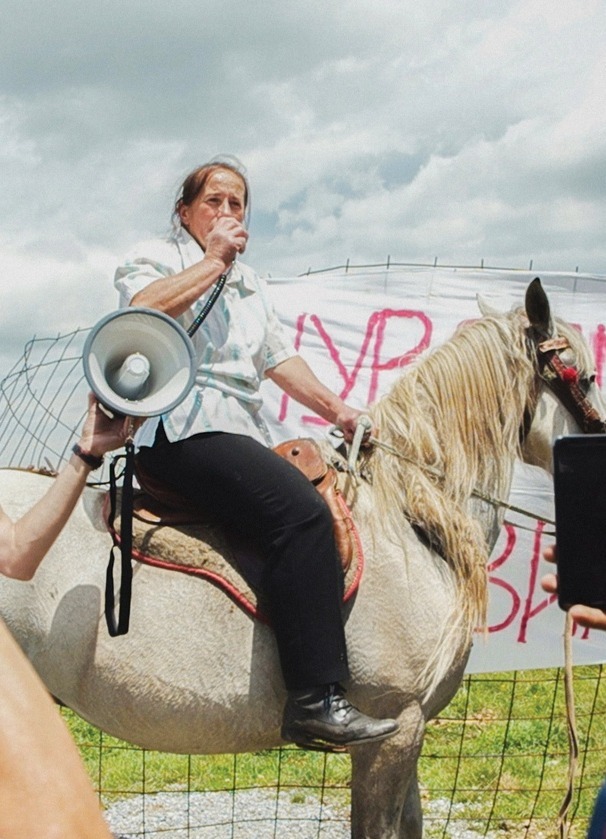
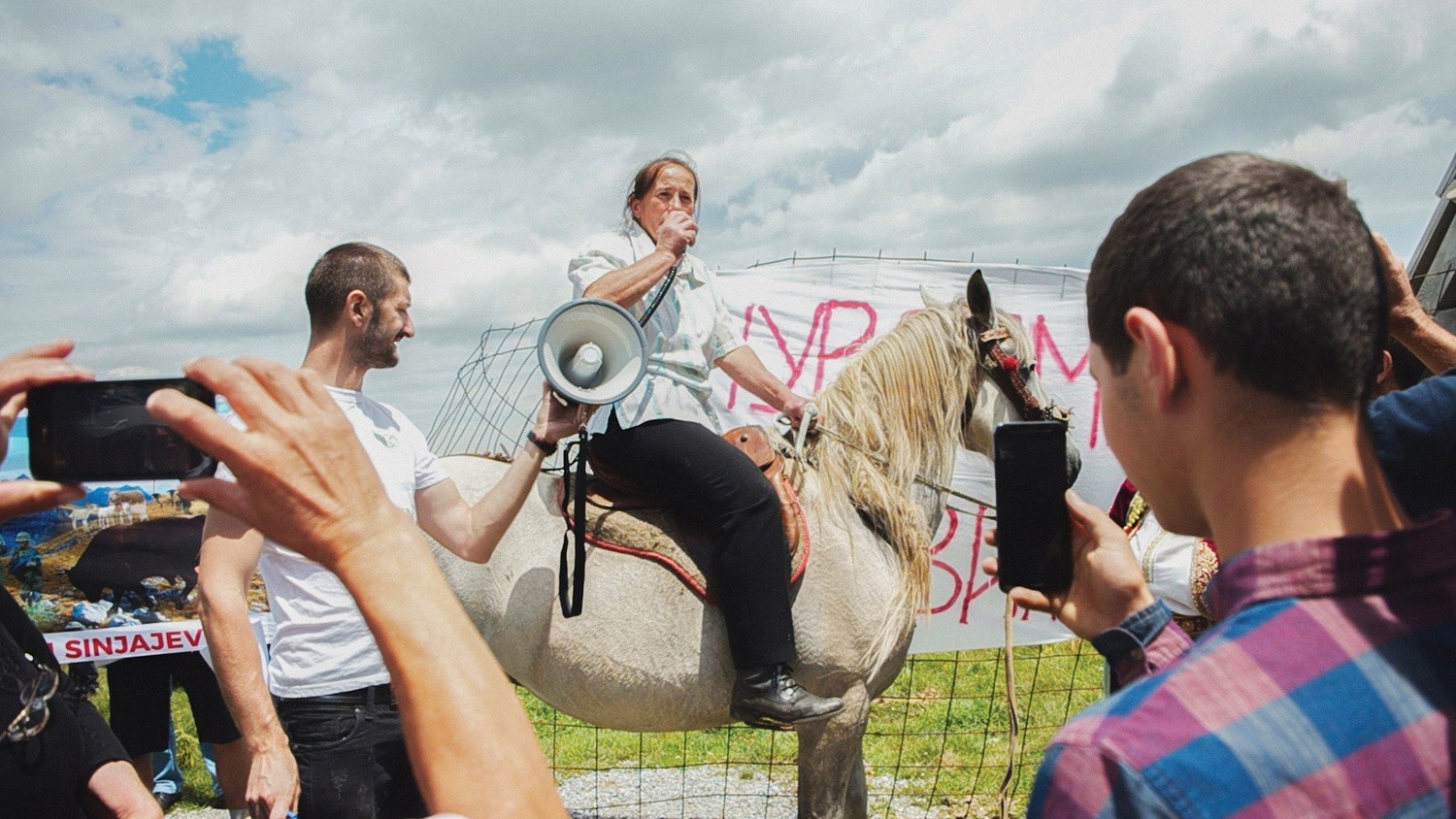
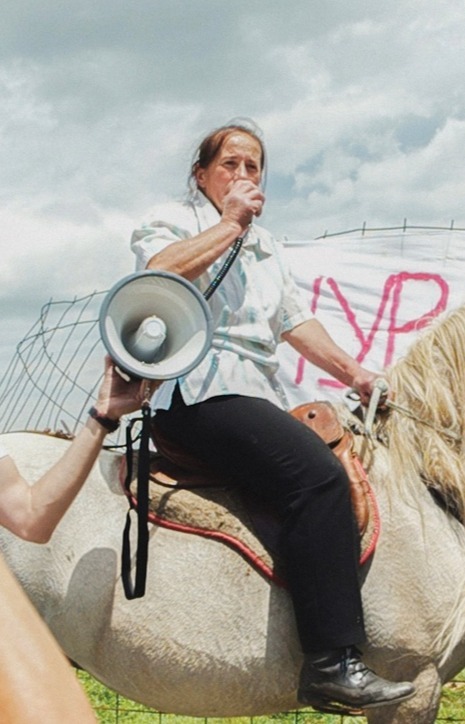
In September 2019, the first international military exercise took place on Sinjajevina mountain. Without any prior consultation with the people who have used this pasture for centuries, military maneuvers began in its heart. Gara (59), leader of the local community in the fight to protect the mountain, and her late sister’s daughter, Nada (13), face two crucial battles—an ecological one, to preserve nature, and a personal, familial one—confronting patriarchy and violence against women. As a documentary, primarily socially engaged, the film captivated me not only with its majestic landscapes but also with the warmth, vulnerability, and authentic emotion that are almost tangible. “The most intimate scenes always happened while we were trying to film something entirely different, often banal. It is clear, when watching the film, that this intimacy could not have been staged.
For over seven years, we quietly explored, lived together, and gathered elements carrying the strength of this place and its people. From the beginning, our director of photography Eva Kraljević was with us. Petar, Eva, and I shared a shepherd’s hut of about twelve square meters, without electricity, water, or phone signal. We did not ask questions—we listened until the story revealed itself. Gara and Nada represent all mothers and daughters through the centuries who, despite everything, nurtured a culture of love. The film is also our reflection on the deep bonds between women and land, patriarchy and militarization, duty and love.”
From the first encounter with Gara and Nada, it was clear they were cinematic heroines, part of a much larger story—like epics from long ago but deeply rooted in a painful present. Their fate carried echoes of Greek tragedy, which made us feel the need to be with them and understand their paths. At what point did they realize they were no longer filming just one event, but participating in a process that transforms both them and the protagonists, and how did that redefine authorship responsibility? “You asked the crucial question. Responsibility and ethical approach are core values that guided our long-term process. It was clear that, conditionally speaking, a much stronger film could be made using all the dramatic elements contained in Gara’s and Nada’s fate, as well as that of their community.
However, when Gara gave us a clear sign that she wanted to share her story, we decided to build the approach and poetics around the taboos present in our local cultures.
For a long time, we were interested only in the contrast between the silence of everyday life and the political context, but in the rhythm of our mutual trust, the process deepened organically. Much later, I realized that it was actually Gara who, in a way, chose us to tell her story. That was the best thing that could have happened. Gara is an extraordinary woman, and meeting her and Nada resulted in great friendship and trust.”
The filmmakers describe the film as a feminist western opera, and the invisible protagonist in this western is, in fact, patriarchy, bringing us back to the beginning of the story: husband-wives who were pillars to everyone except themselves. They endured, remained silent, and—if they were lucky—survived. “Behind the historical continuity of violence lies historical patriarchy. It also hides behind the widespread militarization of the world, as well as behind states, religions, and systems. I believe that in the very principle of rule by force—whether in a state or family—there is something fundamentally wrong. Violence, unfortunately, is not abstract, but it stems from an abstract perception of reality to which women are less prone, as they are traditionally tasked with feeding families, raising children, and cultivating the land, often at the expense of brothers.
In this film, we contemplate the deep connections between women and the land, patriarchy and militarization, duty and love.”
At Sundance, the film will be shown in the prestigious World Cinema Documentary Competition, which brings together the boldest and most outstanding contemporary documentary works from creators around the world. “I hope the audience feels empowered and recognizes that it is worth fighting for fundamental rights and values, despite global disillusionment with institutional democracy; that arming and militarization rhyme with violence; that proud and strong women live in the Balkans—and that such women exist in all cultures, often in the shadows.” And there, on the front line of defense, the unspoken is drawn from the chest step by step, gallop by gallop, changing the order and values left as a legacy for the next generation of women.