First Row With Vedrana Božinović: When Human Rights Become an Act of Rebellion
Nataša GvozdenovićFebruary 2, 2026

February 2, 2026
In a time when grand words are easily worn out, and concepts like freedom, dignity, and human rights slip into abstraction, Vedrana Božinović’s artistic expression persistently brings them back into the body, voice, and responsibility. Primarily an actress but also a dramaturge, and a two-time recipient of the Sterija Award for dramaturgy (Hasanaginica, M.I.R.A.), Božinović has for years navigated the edges of form, language, and systems—where art ceases to be a safe space and becomes a realm of ethical risk. The occasion for this conversation is the play Utopia, created at the Novi Sad Theatre under the direction of Andraš Urban. At its core lies the Universal Declaration of Human Rights, a document more than seven decades old, which today, when spoken on stage, sounds almost subversive, as if it does not belong to the world that formally accepted it. Through the actor’s body and precise dramaturgical structure, the legal text transforms into an emotional and social mirror of the time we live in.
In her conversation with Vogue Adria, Vedrana Božinović speaks about dramaturgy as a puzzle without a final solution, theatre as a space of dignity that must not be reduced to safe decoration, feminism not as a slogan but as a lived personal and professional choice, and her collaboration with director Andraš Urban, in which the boundaries between poetry, performance, and rebellion dissolve.
I watched the play Utopia at the Desite Central Station theatre festival and later at the Novi Sad Theatre; these were working versions of the play in progress. How does your relationship as a dramaturge change the moment the process has to be finalized and presented to the audience?
The first moment someone from outside enters the play, someone who hasn’t been at the rehearsals constantly but comes to see the play at a certain stage, for me as an actress, that is the premiere. It took me a long time to realize that we give the premiere too much importance. The premiere is for whoever is seeing the play for the first time, not for the twentieth performance. And they deserve to see the actors performing with the same excitement and joy as they did the first time. Not to mention, they should be seeing the same play. For me, the performances in Subotica at Desire and later in Novi Sad were just as important as the official premiere for the 52nd anniversary of the Novi Sad Theatre. The play was evolving, that is certain. For the first time, I had the opportunity to experience audience energy and feedback twice, and fortunately each time we received an even stronger confirmation of how important it is for the text of the Universal Declaration of Human Rights to be spoken and heard. In the performance, you see people who, already by the second article…
Exactly, they ask themselves where we even live. The Universal Declaration of Human Rights is a document translated into more than 500 languages. It can be found online with a single click. All UN member states are signatories. The document is seventy years old. It was created as a framework for a civilized social order. And today it sounds like a conspiratorial manifesto. Like something born entirely underground. Like a call to overthrow the system. It is such an irony. And an incredible absurdity.
The Declaration is a legal document, written in dry, legal language. I think Andraš managed to find poetry and pain within it. He succeeded in making us truly hear it. Gabrijela is an incredible actress. When she says that all human beings are born free and equal in dignity and rights, it resonates. Almost like an accusation. And it continues like that to the very end. Gabrijela also has a kind of wild, volcanic energy as an actress. She makes you shiver. Makes it matter to you. Makes you almost want to cry. That is a great skill because this text is devoid of emotion. I think that by working together, Andraš and Gabrijela managed, through the 30 articles of the Declaration, to make us aware of the time we live in. For anyone who reflects on the world around them, this is indeed a time of absurdity. As if everything we have known and believed in is collapsing. Our world is collapsing. And in that collapse, we discover how vulnerable and unprotected we are as human beings, born free and equal in dignity and rights. Nothing protects us anymore. Everything has become so perverted that I don’t even know what historical moment we are in.
Related: Maša Dakić on the monodrama that sparked change and sold out overnight
I am not a dramaturge by profession, I don’t have a craft, and I think craft is very important and I respect it deeply. What I can rely on is only the experience I have as an actress, but also my many years of writing experience. I think actors think differently. Not better or worse, just differently. As an actress, I never dealt with wholes. It was only in my first production, Simović’s Hasanaginica, which I worked on at the Novi Sad Theatre with Andraš, that I understood what it means to work with a whole. What drew me to dramaturgy, and it may sound naive, but it’s true, is my love for puzzles. Every play is like a huge puzzle. The director decides which part of the picture they want to show, and you, as a dramaturge, have to be aware of the whole picture, find all the pieces the director wants to highlight, but also use a bunch of pieces that were never part of the original picture and yet relate to it. Madness. Exciting. You enter blind alleys, look for a way back, wander, search, don’t sleep, listen, watch, arrange, disassemble, fold, and you never know if it will work. In all of this, I’m not sure it can be only architecture, because the structure of each play is almost like the neck of a long crystal glass for special occasions from the shelf—you can’t hang weights on it, you have to be careful what and how much you hang, and sometimes that’s a matter of intuition, not just rules. It’s delicate. And yet a living organism breaks free, living its own life. And that can’t either. I don’t know. I’m not someone who works by rules, nor do I have rigid beliefs about how something should be done. I check a lot—how it plays, how it can be said, whether it can be said at all. I look from an actor’s experience to see if it works or not. And I perform all the roles myself (laughs).
Photo: Roland Bajari
It is never calm waters. Urban can build and dismantle an entire world in a single sentence, which is phenomenal, because there are no worn paths. But it is not easy to follow. Again—as an actress, I don’t believe in democracy in theatre. I especially don’t believe in democracy within a single theatre process. For me, the director is the primary authority, and it’s not a question of inferiority but of order. I don’t understand this general conflict over who is the most important in theatre or in a production. I have never felt inferior as a performer, nor superior as an author. The challenge is to respect someone’s vision while also contributing what you do best. I would like to be a collaborator who allows the director to soar. I would like to… But emotionally, these processes have never been easy for me either. In terms of working on oneself. It is not always easy to dismantle yourself along with the play. I think, as an actress, what helped me most were the rehearsals I did as a dramaturge. Which may be absurd, but it is true. The best description of our collaboration, and my favorite, is that I am the magician’s apprentice. And that position suits me wonderfully.
Both theatres I would move to as an actress right now are connected to Urban. And considering his way of working, that is certainly no coincidence. One is Deže Kostolanyi, which he led, and the other is the Novi Sad Theatre, which he leads now. I love discipline because I believe it does not mean not being an artist. Discipline is also about what you eat, what you read, what you allow to poison you or not, how much you respect the people you work with, all people, how much you respect yourself. These are two extremely disciplined ensembles, where the awareness that a theatre performance is a collective act is strongly felt. Knowing how to play for the team is something I deeply value. Although actors think individuality doesn’t show there, I see the actor most clearly in collective scenes. There, you see how much someone loves themselves in art or loves art within themselves. So, I love and respect the Novi Sad Theatre, and it is a privilege and an honor to work there for the second time. You said beautifully that Hasanaginica is a female scream. It was a homage to all the things I had to stay silent about as a woman, because in real life, you cannot scream. It’s not proper, they say. Then theatre is there so you can express what hurts the most. The dedication and quality of the actors in the Novi Sad ensemble helped that scream to be heard. In Utopia, I think it is very important that the Universal Declaration of Human Rights is spoken by a woman. It carries a different weight. And this has nothing to do with the feminism trend. I am not following trends. I see feminism as a fight for human rights. That’s it. I am generally repelled by trending activism. When you can hardly say anything different from what everyone says online, because you will be lynched. If you don’t wake up with something and go to bed with it every day, if it isn’t something you carry with you at every moment, something you constantly question and through which you question yourself—then nothing. My feminism is not for posters. I live it and practice it. And I pay the price.
Everything in life should be a space of dignity—and theatre, the doctor’s waiting room, the street, the house we live in, the place where we work… I will never accept that it isn’t. And I will never stop fighting for it to be.
The only thing that matters to me in theatre is that it moves me. If we castrate theatre, we do it out of pettiness; that has nothing to do with theatre and everything to do with ourselves—to protect ourselves, “let it be about nothing, then it won’t upset anyone.” Fine. But—what for, and for whom? Theatre without risk is meaningless. But it’s also meaningless if it isn’t fun.
Because I love it immeasurably. I started acting during the war in Sarajevo, when the lights went out in the hall and the air-raid sirens went off at the same time. By candlelight and to the sound of bombing. When you start like that, it’s a vow. Theatre is a space where completely different people, total strangers, people with opposing and the most varied views, and even people without views, breathe together. As long as that exists, I have nowhere else to be.
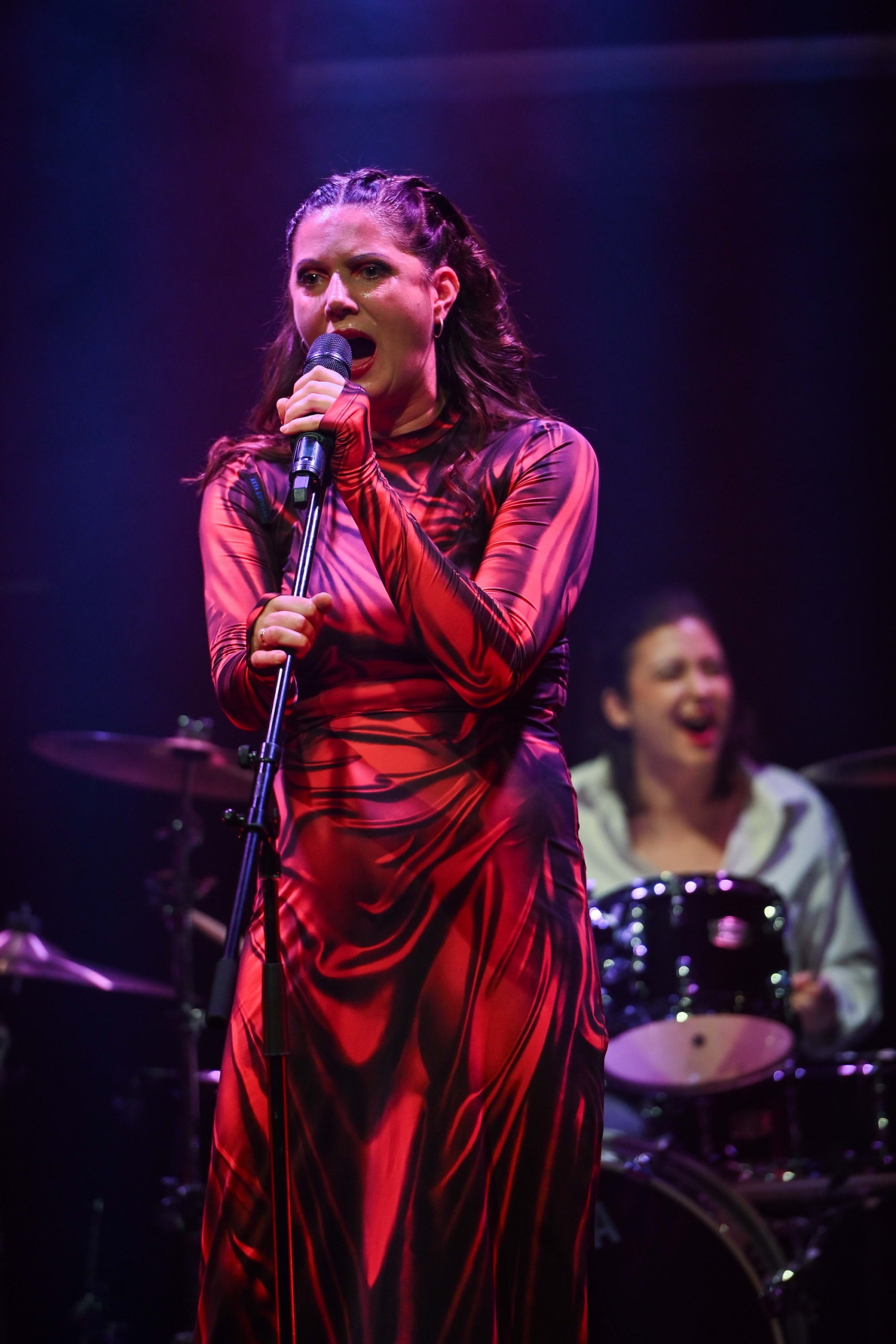
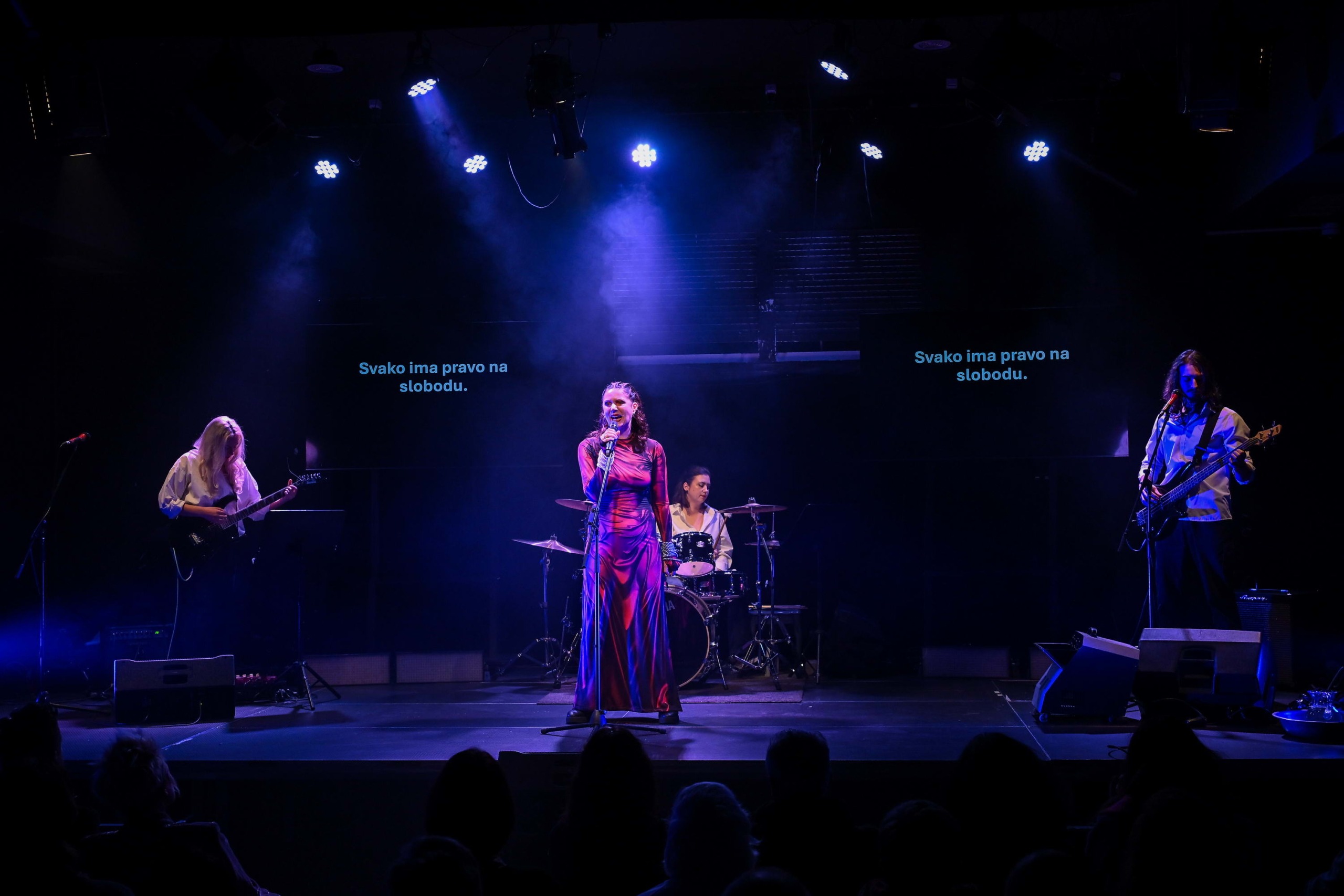
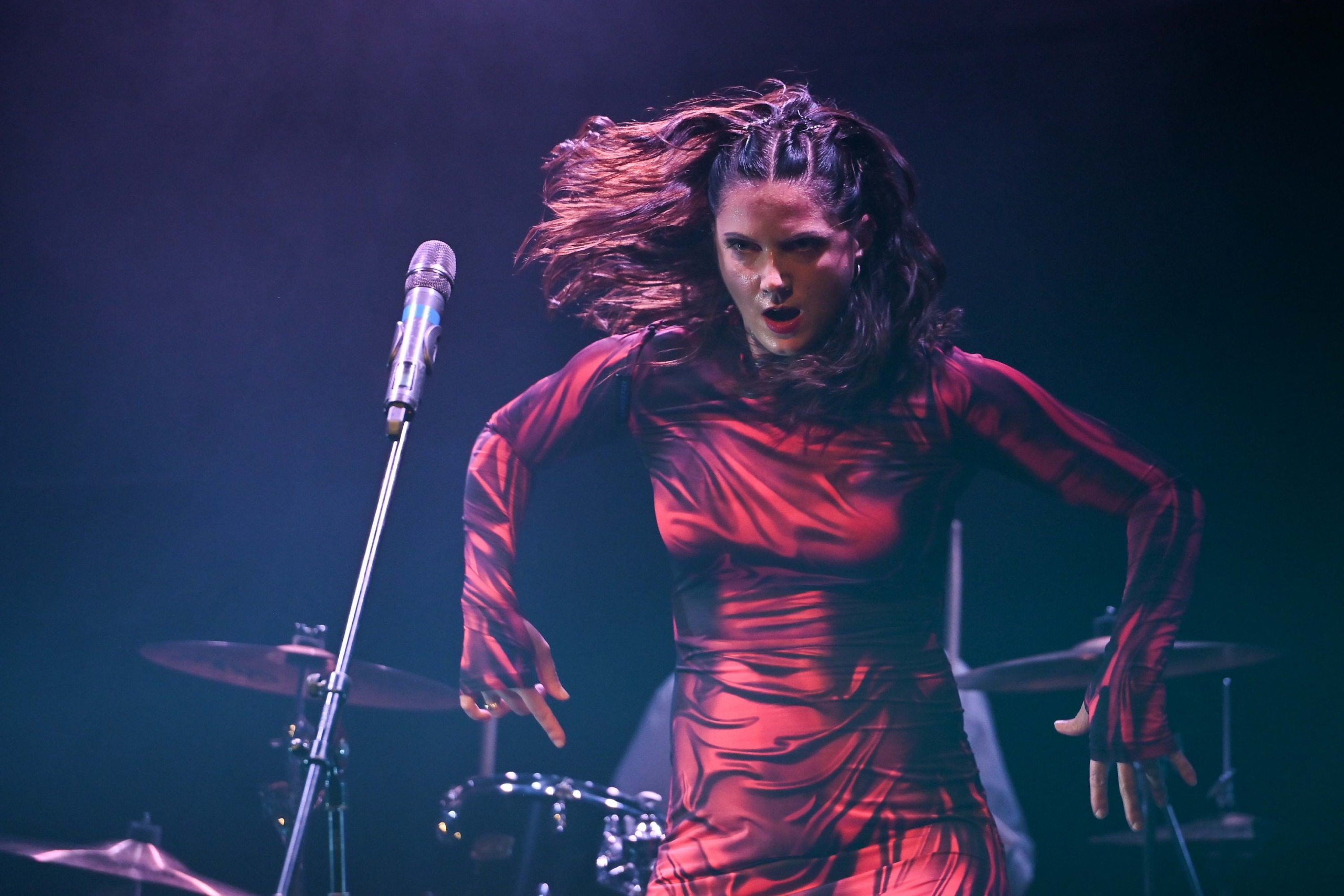
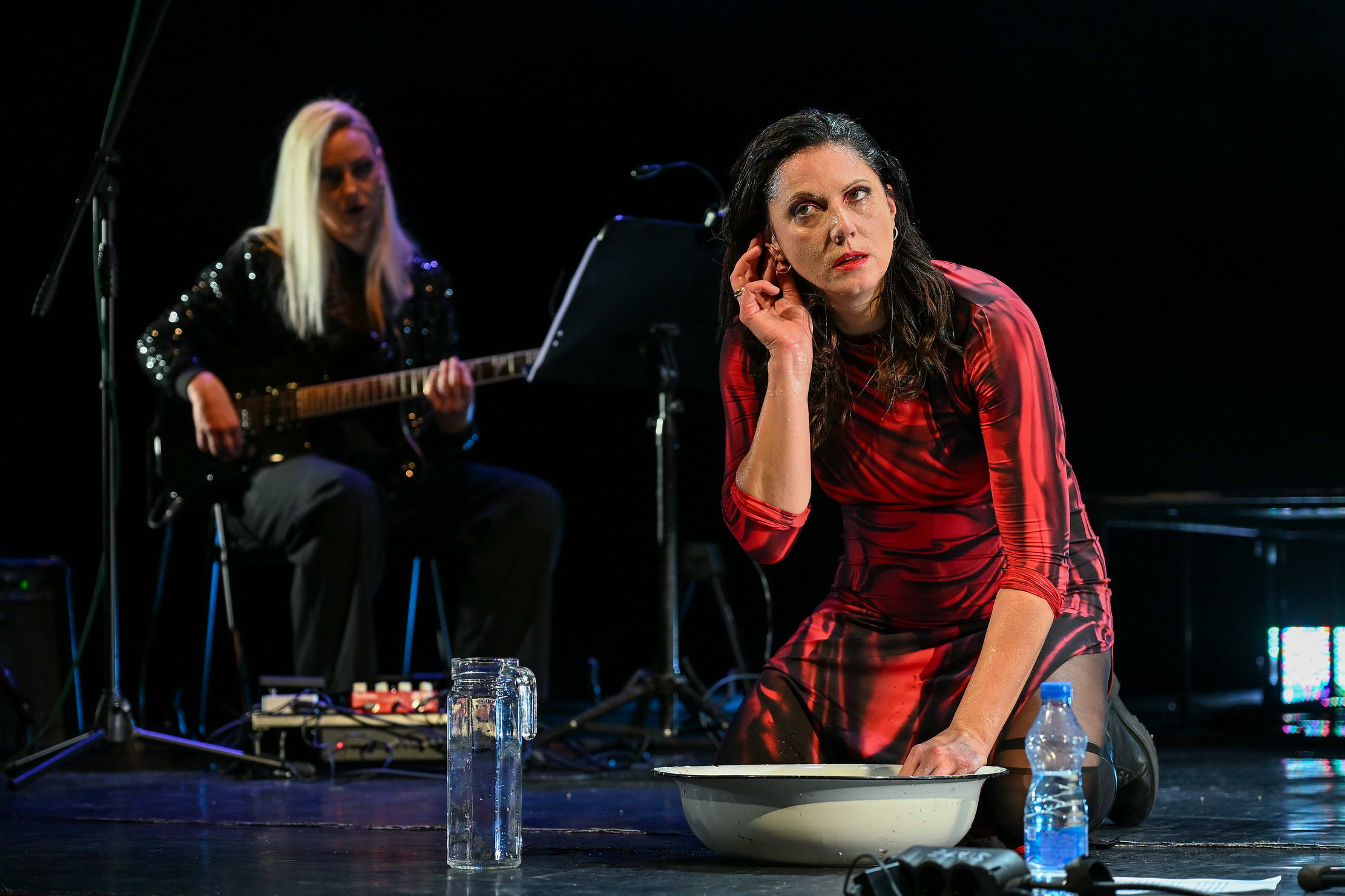
Photo: Edvard Molnar