How slovenian Ofis Architects continue to redefine what existing buildings can become
Tina KovačićekDecember 11, 2025

December 11, 2025
Around the same time I heard that Slovenian architect Špela Videčnik from the studio Ofis Arhitekti would be coming to Zagreb on December 12 to present the work of the award-winning Ljubljana practice as part of UHA’s lecture series Mies in Zagreb, I also received information about their new project completed this year. And it was clear it deserved a story of its own.
Ofis Arhitekti are already in the running for the prestigious EUmies Awards 2026 with two projects: the renovation of the former Mladinska knjiga printing house in Ljubljana (2024) and the reconstruction of Villa Muhr in Bohinj (2025). Their latest project, House Under the Poplars, arrives as a graceful continuation of what I’ve come to admire in their work. They’ve repeatedly shown how well they navigate the challenge of rethinking and elevating iconic existing architecture. Alongside the Mladinska knjiga renovation, another strong example is the transformation of a neglected modernist house into a project worthy of admiration.
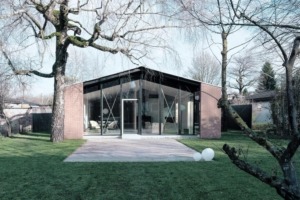
Photo: Tomaž Gregorič
House Under the Poplars is located in Murgle, one of the most influential postwar housing experiments in Slovenia. Designed by architects France and Marta Ivanšek and built in phases between 1965 and 1982, Murgle became a quiet yet radical model of ecological, human-scaled living long before sustainability became a discipline. As the architects note, it’s a neighbourhood clearly built ahead of its time. Its identity isn’t defined by standout architecture but by a collective, low-tech intelligence: wooden houses resting on simple strip foundations in swampy soil, breathable roofs, porous street edges, and an urban logic shaped by the geometry of existing trees. What’s especially interesting is that the entire neighbourhood embodies an imported Nordic ethos. The architects absorbed Scandinavian thinking during their stay in Sweden, then reinterpreted it for Ljubljana’s climate, culture, and materials.
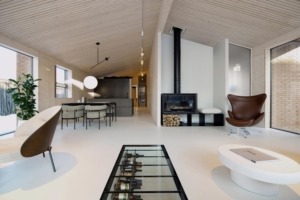
Photo: Tomaž Gregorič
The Ivanšek duo’s concept relied on preserving the large trees already growing on the site. The placement of the buildings followed this geometry, which created a gentle irregularity, and the streets were named after the trees they grew beneath. The houses are modest in size but more than sufficient for comfortable living, the architects note, adding that they’re architecturally unobtrusive, woven into the landscape and barely visible among the trees. Originally envisioned as housing for working-class families, Murgle quickly became an elite neighbourhood thanks to its exceptional spatial qualities. Today, it remains one of the most desirable places to live in Ljubljana.
The very thing that makes Murgle so special is also what makes it difficult to work with. The architects had to ask themselves a key question: how do you renovate a neighbourhood built by private owners, each constructing their own house according to uniform urban plans, without erasing the ecological and social DNA that makes it extraordinary?
The project became a test case for the future of the neighbourhood, showing that renovation can improve performance while protecting the fragile architectural consistency that has made Murgle one of Ljubljana’s most desirable places to live.
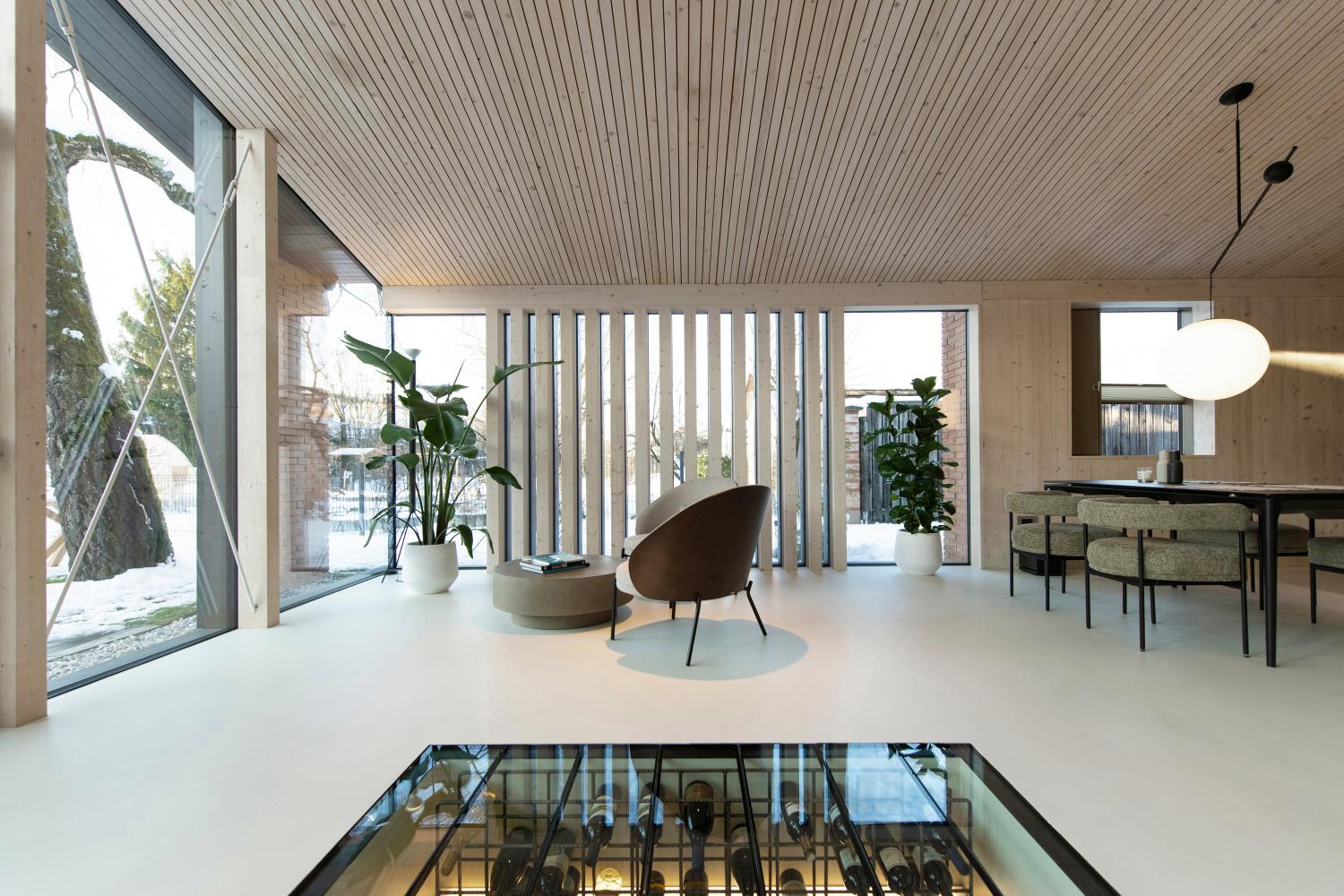
House Under the Poplars was once the last in a row of atrium houses, slightly detached and oriented toward the park, which gave the renovation a rare chance to expand the otherwise compact floor plan typical of Murgle. But the original structure was no longer usable: the facade and roof contained asbestos, and the timber construction didn’t meet today’s standards. The architects carefully dismantled the house and rebuilt it using cross-laminated timber, faithfully keeping the original proportions, form, and the quiet simplicity characteristic of Ivanšek’s 1980s architecture. The new house is ecologically efficient, energy-reliable, and executed in a contemporary way, yet it remains visually discreet, exactly as the spirit of Murgle demands. The result is a home that meets today’s standards while preserving the modesty, clarity, and human scale that define the identity of the neighbourhood.
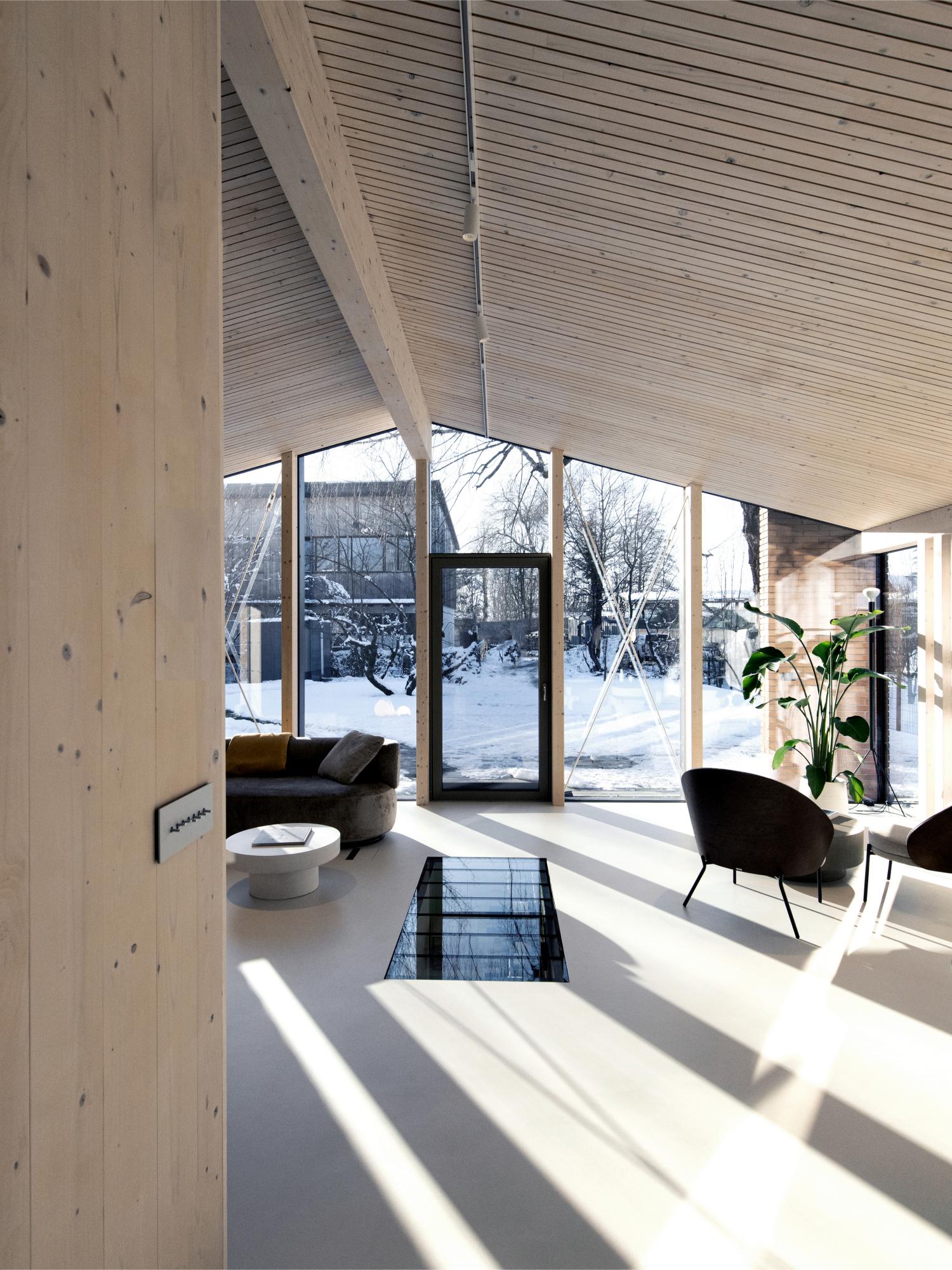
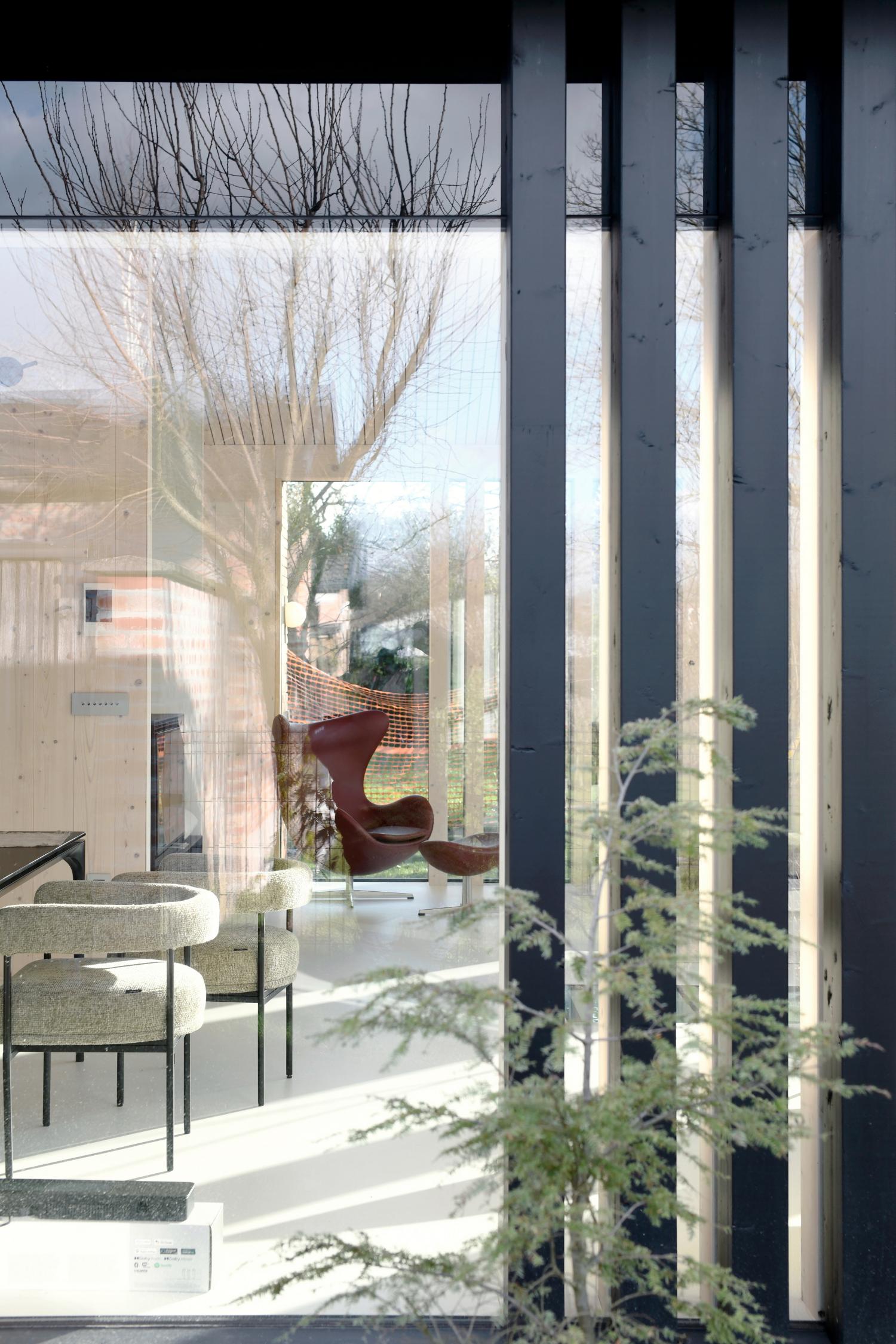
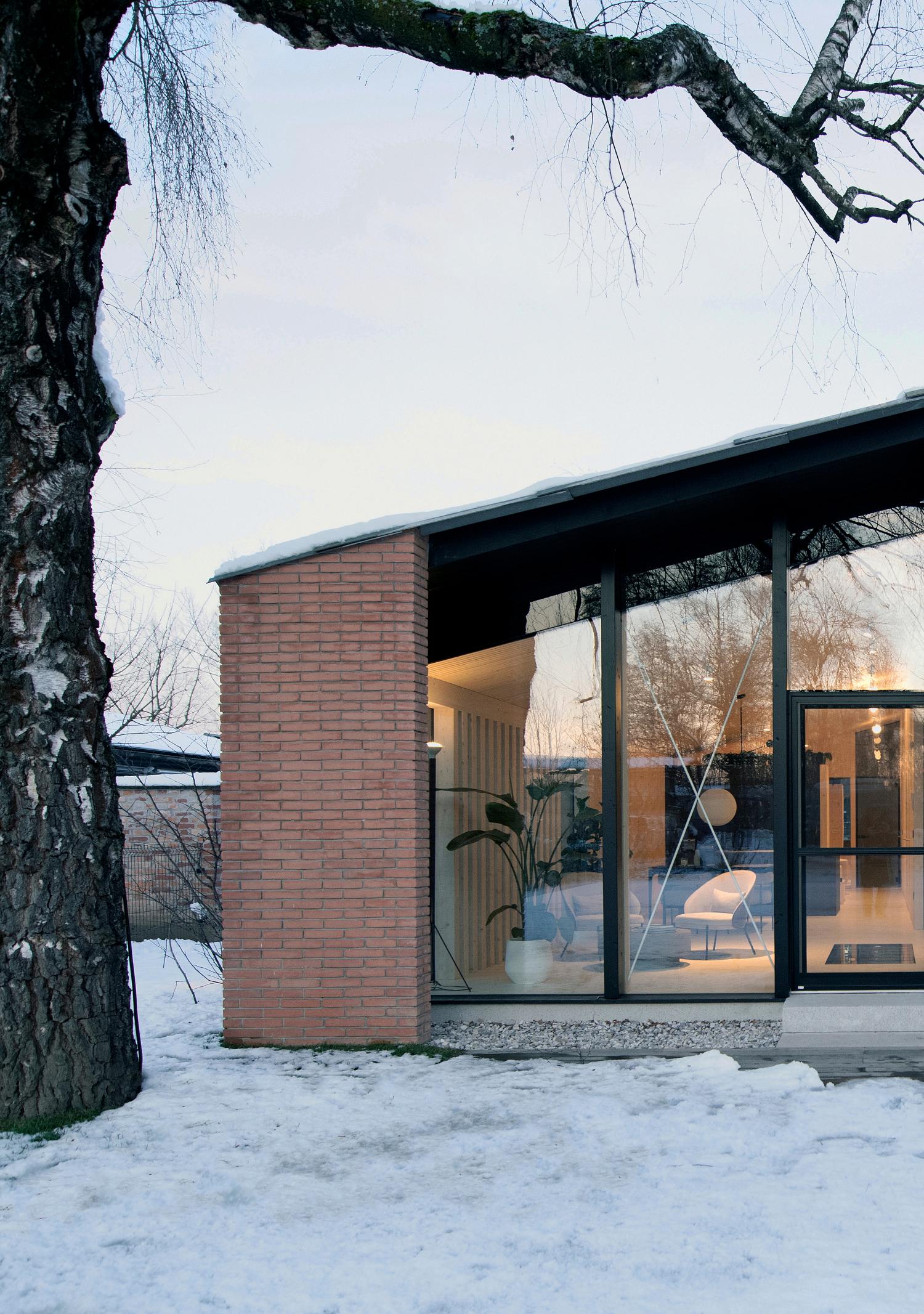
Because the west side of the house faces the park, the extension could take on a more open and free form, while still staying rooted in the spirit of Murgle. The new volume was designed as a light pavilion of timber and glass beneath an elongated roof that ties the old and new into a coherent whole. Two brick columns, identical to those on the original facade, act as a subtle link to the neighbourhood’s architectural tradition. Timber side walls create privacy and protection, while the glass frontage opens fully toward the garden. The large birch tree, one of the site’s defining features, was preserved as well, with the foundation adjusted to protect its roots, continuing Murgle’s ethos of building in dialogue with the trees.
The result is a space that works both as a living extension and as an intermediate climatic layer, a contemporary reinterpretation of the low-tech ecological logic that made the original Murgle houses so successful.