Daniel Tomičić on Croatian artists to watch in 2026 and how to invest wisely
Tina KovačićekDecember 24, 2025


December 24, 2025
Art Zagreb just wrapped up, a fair that since 2018 has been boldly bringing together artists, gallerists, collectors, curators, and audiences, creating a space for dialogue and fostering trust within the contemporary art market in Croatia, with potential to expand regionally. I say boldly because the market here is small and particular. Daniel Tomičić, director of Art Zagreb and the Zagreb Design Week festival, told me the same when I asked him which artists are currently worth investing in. “In Croatia, it’s impossible to advise investing in young artists. Simply put, there’s no system that allows them to build a career alongside your investment. The situation gets even stranger when it comes to pricing, with students often asking for more than their professors. How far we are from a proper system is perhaps best illustrated by Ivan Picelj. His recently concluded retrospective at the Museum of Contemporary Art in Zagreb—the highest form of recognition—had absolutely no impact on the market.”
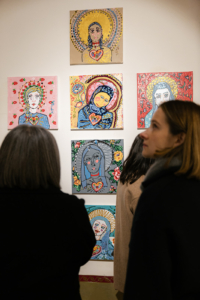
Courtesy of Art Zagreb 2025.
The art market in Croatia is slowly but steadily developing, and local galleries are increasingly stepping onto the international stage, a conclusion that becomes clear after this year’s Art Zagreb fair. The fact that galleries from Croatia, Hungary, and Serbia showcased over fifty artists in Zagreb, ranging from legends like Joseph Beuys, Marina Abramović, Mladen Stilinović, Boris Demur, Vladimir Dodig Trokut, Ivan Picelj, Goran Trbuljak, Vlado Martek, Boris Bućan, and Dušan Džamonja, to younger artists opening new chapters in Croatian and regional art production, including Caroline Barbarić, Nikolina Šimunović, Jessica Gobert, and many others, speaks volumes about the market’s dynamics and artistic trends.
If you’re thinking about investing, here’s the only advice from Daniel: “If you do decide to invest in young artists, the only guidance is to follow the criteria used in established markets, with the hope that they will one day hold here too. Choose artists who have exhibited solo in top galleries like Zen Contemporary Art Gallery, Galerija Kaptol, Galerija Kranjčar… and who have won expert awards such as Erste Fragmenti, the Radoslav Putar Award, or the HDLU Award for Young Artists. This way, you’re buying works whose quality has already been validated by professionals.”

Monika Sinković / Courtesy of Zen Contemporary Art Gallery
As a potential art investor, one thing you’ll definitely follow—and Daniel agrees—is that you should primarily choose works you personally like. “In general, for any investment in art, it’s important that you enjoy the pieces, that their art communicates with you. Unfortunately, with young artists, this is often the only certainty. Still, they’re just starting their careers, the art market is developing, and you have to trust that the value of works by the best young artists will grow.”
In a brief overview of the current market, Daniel shared with Vogue Adria three artists to keep in mind for potential art investment.
Monika Sinković (b. 1997) is a young painter who has already established her own style. Her work is defined by figuration, human motifs, large-scale formats, and a palette dominated by reds.
Matej Vuković (b. 1995) is a sculptor who first drew attention in 2018 with his series of cloud sculptures. He won the second Ivan Kožarić Award in 2021, presented by the Museum of Contemporary Art in Zagreb to emerging artists.
Photo: Courtesy of Zen Contemporary Art Gallery
Finally, a recommendation for investing in an artist from the previous century— Ivo Gattin (1926–78) was a Croatian artist active in the second half of the 20th century, working in the spirit of Art Informel and informal art. He experimented extensively with various techniques. As a key figure of the 1950s and 1960s—a period of Croatian art currently attracting the most interest—he has remained relatively overlooked. For this reason, Gattin represents an intriguing investment today.
Photo: Avantgarde Museum / Marinko Sudac Collection (first photo), Avantgarde Gallery