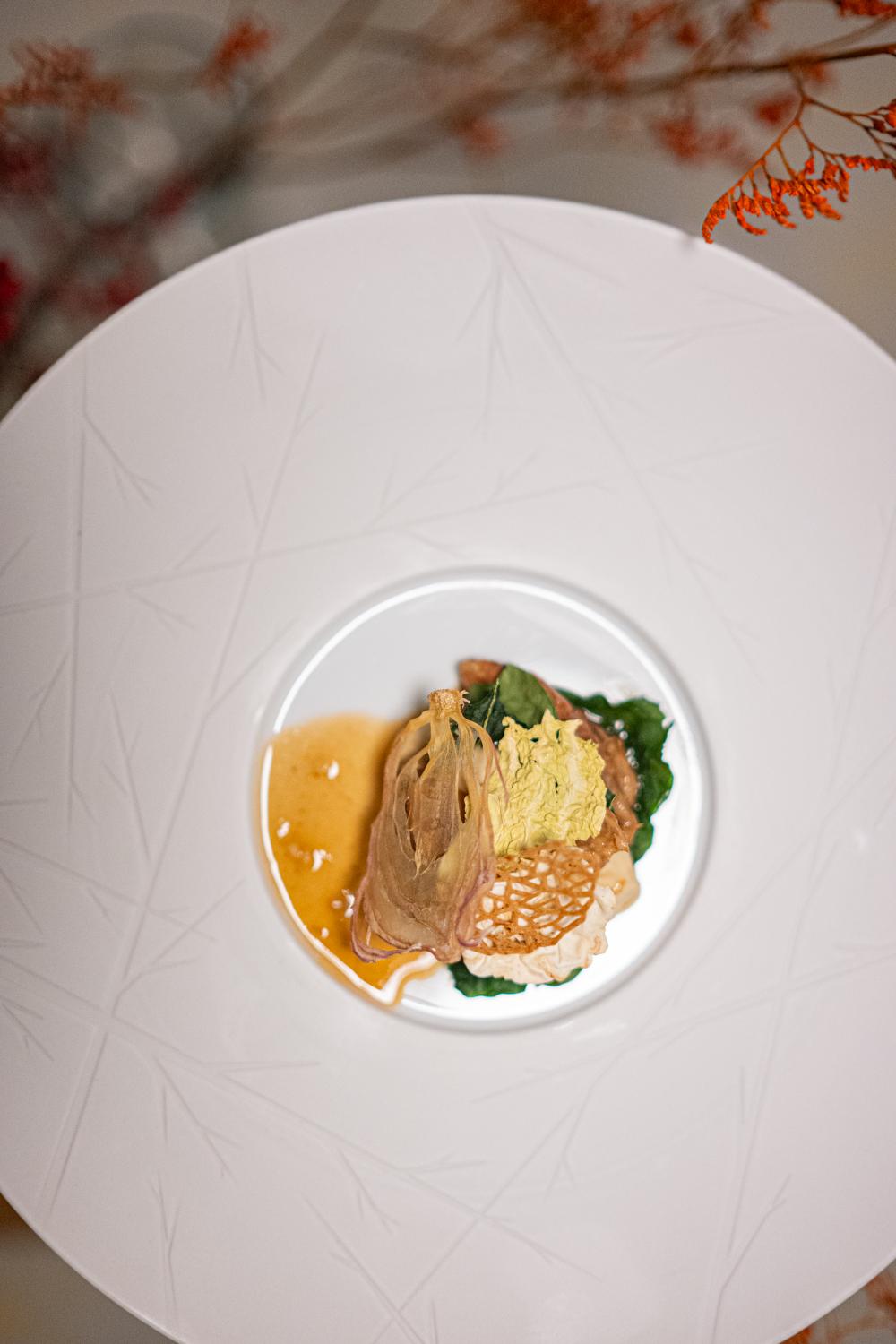
The cooking lessons I didn’t expect to learn from a Michelin-starred chef
Tina KovačićekJanuary 26, 2026

January 26, 2026
For some time now I had wanted to visit Workshop in Zagreb, a new space in the city that aims to be a home for all of us who are curious and hungry for new experiences. “Mornings are for coffee. Afternoons for creativity,” they say here, and they mean it seriously.
A pleasant minimalist interior, neither small nor large, where from 8 a.m. to 3 p.m. you can enjoy coffee, and in the early evening it offers a creative workshop almost every day. All the furniture in the space was made by the young Jakov Habjan, co founder Luka Cindrić tells me, with whom I immediately share my delight at finally being here, and ask how things have been going in these six months since opening. He smiles with satisfaction and the ease of someone who, despite numerous obligations around his own architectural studio, successfully navigates the responsibilities of Workshop as well. “We’re fully booked and people really like what’s happening here. You have to come to the other workshops too, for example Latino on a plate, or the workshop where you make your own gin with Luka.” While my fingers are already flying to their Instagram to check the schedule, Tibor Valinčić is ready behind the counter to teach us how to arrive at an idea and prepare a dish from scratch.
I put my phone down, ground myself, ready to hear the tricks of a Michelin starred chef from the Zagreb restaurant Dubravkin put, and to apply them in my own kitchen.
“Every dish we start working on begins with some idea. I ask myself: why did I decide to make this dish? Personally, I have three ways of arriving at the answer. The first is the technique I want to use to process the main ingredient I have in mind. From classic home techniques these are roasting, confit, boiling, grilling. For example, you walk through the market, see a squash and think about how you want to prepare it. The second way I come up with ideas for creating dishes is deconstruction or modernization of existing recipes, where we want to make a different version of the same dish. There are classics like Beef Wellington, Carbonara, sarma, anything you want to prepare in a new way. And the third way to arrive at an idea for creating a dish, and in my opinion the most important one, is seasonality. We choose an ingredient that is at its peak and want to highlight it,” Tibor says with the elegant calm of a chef who has a structured approach in his kitchen.
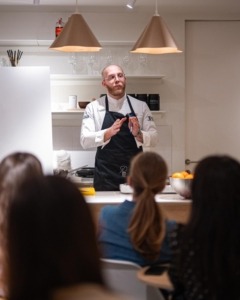
Photo: Sanjin Kaštelan
Somewhere around here my introspection begins: where am I as a cook in all of this, opening up a completely new area of awareness for me, until now a rather free style gastro approach. My culinary skill is actually quite modest, my menu revolves around about ten dishes, yes, only that many, but I mean recipes I do not need to look up in a notebook, and whenever I think about what I could cook today, my brain explodes like a sprinkler and I mentally travel from Zagorje to Vietnam, sometimes I even think about the idea of štrukli in a sweet and sour sauce, please do not judge me. After that mental explosion, I always return to a good old Bolognese, dal, or vegetables from the oven. So this introduction that we should start grounded with a basic idea that revolves around three possibilities sat well with my frantic mind that sometimes wants everything at the same time.
Tibor continues to break down the basics of how to prepare a dish worthy of attention at home.
“It is important to know where food comes from and which ingredients are currently in season. I often go to local markets and check suppliers, contact with them is important to me. So choose what is in season.” Around here I think that I have already learned to go rather to the granny with three knobbly carrots than to a vendor who has strawberries in January. And focusing on season is a good way to start if you are struggling with choosing what and how to cook.
“It is important to balance the flavors of the dish and ingredients and find additional techniques that will emphasize what you want from that dish, and how you will make the flavors you have created feel connected. People are also afraid, in my opinion, of the most important ingredient, salt. Do not run away from salt, just do not overdo it and find the right amount. Even a little salt can change a flavor from good to perfect. And make sure to taste the dish during cooking.” Noted. I am the one who does not do that, spontaneously believing in intuition and that the universe will take care of everything else. Mostly I have been lucky so far, then.
Photo: Sanjin Kaštelan
An additional tip:
“When you think about what to serve guests, even when it is a simple platter, think about breadth. Will it be just cheese and prosciutto, or will you add some crackers, jams, sides. The idea is that different flavors create a whole and fullness, that they function as a combination.”
Tibor jokes that this is not about shakes, but slang chefs use. “In the culinary world, when a chef asks you what the protein of a dish is, it refers to the main ingredient. And it can often be a vegetable, not necessarily a protein.”
“This is the technique by which, after choosing the main ingredient, I start adding all the other sides and flavors to create a whole,” Tibor emphasizes. For the purposes of the workshop, our protein was sea bream. What next? “Here we apply the ideas from the beginning of the story. Do we want to roast it, boil it, bake it in salt, and what do we want to serve with it. Let seasonality be the guideline, so for example we can include mandarins.” The next addition was mandarin, which narrowed down some other ingredients because not everything goes together, while Tibor adds hazelnut into the equation. A concrete side for volume should be polenta, flexible enough while you are on slippery ground with mandarin and hazelnut, and at the same time baking in salt.
“Here you decide how you will prepare these four ingredients, with the sea bream baked in salt, so that you gradually get the final form of the dish.” Tibor concluded that grilled polenta is a good idea, then a mandarin gel and a hazelnut sauce. “Here you would create a dish that has a connection between sauce, sides, and additions.”
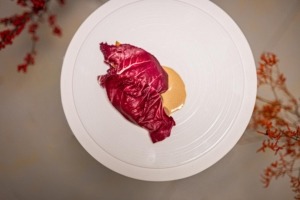
Photo: Sanjin Kaštelan
“Sauce is a very, very important element. Every dish you try with me has some kind of sauce. Pesto, dressing, there always has to be a dose of liquid binder that connects the dish. It can even be a rosemary emulsion, for example.”
“We have salty sea bream, sweet hazelnut and mandarin, grilled polenta with a smoky aroma. What is missing for balance?” Tibor asks us students. Acidity. “We have to find something that will give our dish flavor balance so that after eating it we are not saturated with hazelnut, smoke from the polenta.” Here aceto balsamico is mentioned, which you add at the end with a few drops, or for example lemon with which you can bless the fish.
“Here we think about what to add to the dish so that it has an interesting texture and that after we eat the seventh spoonful, it is not boring in the mouth,” Tibor says and imagines a hazelnut crumble as a fun detail. Also, play with dehydrated textures, you only need an oven, tempura, details that will break up the classic way of serving.
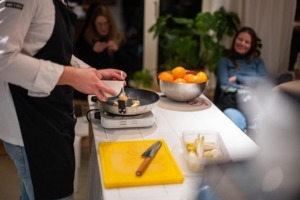
Photo: Sanjin Kaštelan
Only at the end do we think about plating, which should come completely naturally to you. It does not have to be Pablo Picasso on a plate, but it should look neat, clean, and elegant. I also learn that every dish goes through cycles of testing, and that only on the fifth or sixth attempt does it get its final look and flavor. So, home chefs, be brave. Play, try, and experiment, because without that there is nothing new.
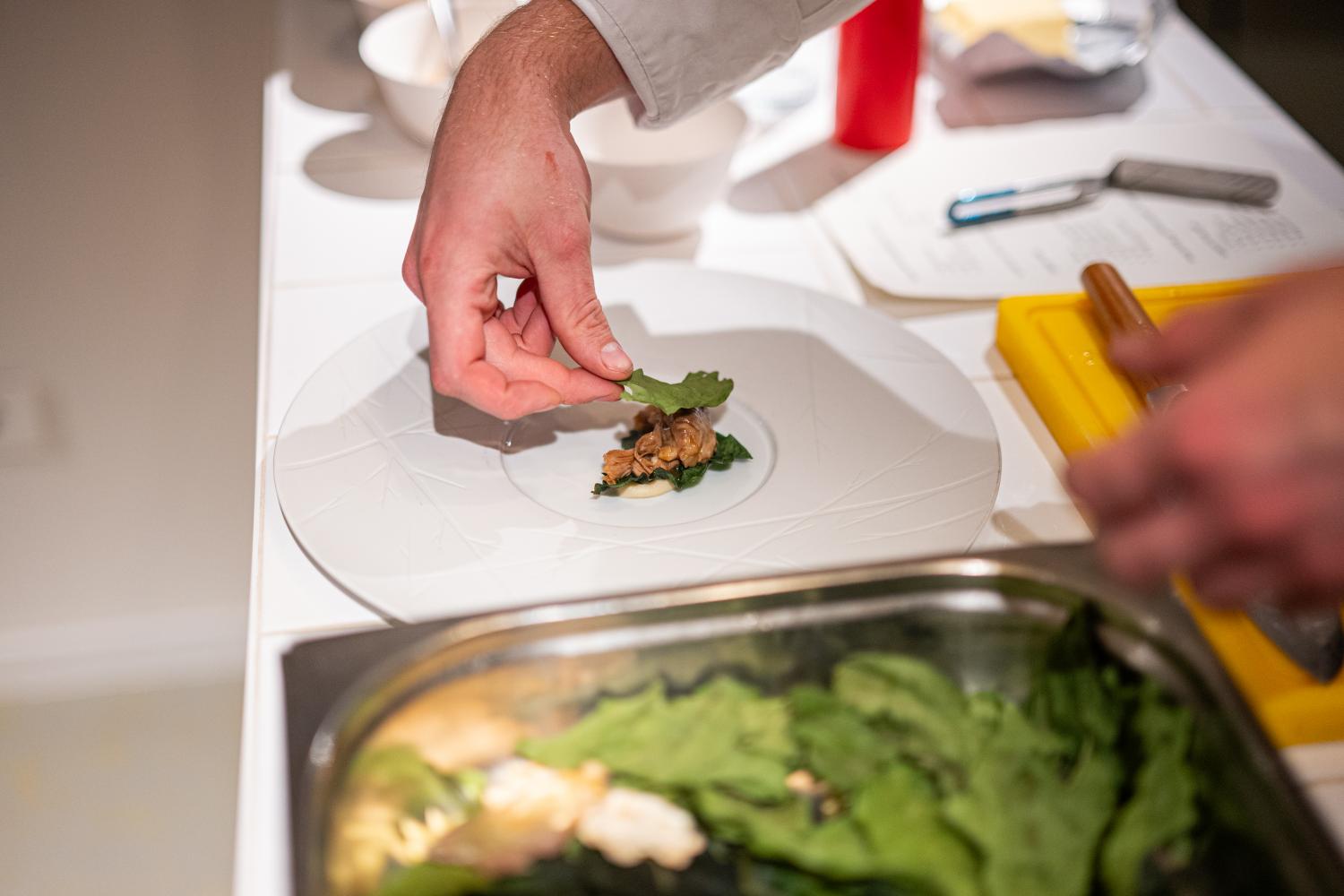
There was also a practical part of the workshop, read: the Michelin chef from Dubravkin put prepared several outstanding dishes for us, but I will leave that for you to experience live. As someone who feels in the kitchen like a high school girl in spring, with the feeling children have when they run toward swings, the workshop was an excellent move for my culinary grounding. Something I had not previously understood in such a structured way, and attempts and experiments would usually end up in the toilet bowl, this workshop guided me and was the best spent two hours of that cold Tuesday evening. Be curious and go to workshops, they always somehow move us forward.