The year 2025 was marked by challenges, losses, obstacles, but also by victories for many of us. We had fun, we cried, and moments like these are often accompanied by films that, in their own way, reflect the collective state of mind. This year was many things, but one thing is certain: it brought a wave of films that kept us glued to our screens month after month, first for the act of watching itself, and then for the obsessions they sparked across social media. When we talk about cult films, a few titles probably come to mind immediately. But what about those that are only just beginning to form? Can we predict them, sense them, anticipate their future status? We may not be able to say with certainty which films will be considered cult classics in ten or twenty years, but there are certain signals we tend to recognize almost instinctively. What makes a film a classic is its story, its atmosphere, the feeling it creates, and the world it builds. These are films we return to not because they are perfect, but because they are distinctive, sometimes stubbornly authentic. They are often tied to a specific moment in time, to social unrest, generational confusion, or a desire to escape, yet they manage to outlive that moment and become something larger, a shared symbol. Below, we have selected six films from 2025 that have the potential to one day earn classic status
I don’t think anyone was surprised to see a film by Italian director Paolo Sorrentino on this list. La Grande Bellezza has long secured its place among cult titles, and it feels safe to say that La Grazia is unlikely to meet a very different fate. Instantly recognizable in its wit and cynicism, and deeply inspiring in the way it creates or perhaps more accurately, expands the archetypes of Sorrentino’s characters that already seem to exist in their own universe beyond the film itself, La Grazia comes across as a quieter, more restrained variation on his recurring themes. The film slowly builds an atmosphere where life and its banality, memory, guilt, and tenderness intertwine without clear boundaries. Sorrentino does not shy away from pathos here, but he handles it with care, almost shyly, as if fully aware of how thin the line is between sincerity and theatricality. The characters are once again larger than their individual stories, yet at the same time more vulnerable than we have seen before. When I watched it for the first time, I immediately knew I would want to return to it, in a few months or in a few years, the timing hardly matters. That urge to revisit a film is always my first warning sign that it might one day become a classic.
Sinners, Ryan Coogler
I love vampires. I love vampire books and films, (nothing new for those who know me well, they are fully aware that Twilight is my ultimate guilty pleasure). What sets vampires apart from classic horror, a genre I’m often not drawn to, is their ability to express something deeply human and painfully real in an intense, unsettling, and highly metaphorical way. Sinners might be my favorite film of 2025. What puts it so confidently at the top is the fact that at no point did I know what the next second would bring. This is as close to horror as I can comfortably go, although I wouldn’t necessarily classify it as a horror film outright, even if many of its elements are undeniably present. Coogler uses the vampire myth not as mere genre decoration, but as a tool to speak about guilt, desire, power, and inheritance. Honestly, what could be better? This is not a film about monsters lurking in the shadows, though don’t be mistaken, they are there. It’s about people slowly turning into something else, often through their own choices.
The atmosphere is dense and heavy, charged with a constant sense of threat, yet without relying on familiar horror tricks. Fear doesn’t come from jump cuts or loud music, but from uncertainty, from glances, from silences that last just a moment too long. The film keeps shifting the ground beneath your feet, pushing you to question who you can trust and what evil even means within this story. Its potential to become a classic lies precisely in that elusiveness. Sinners is not a film that fits neatly into a category, nor does it offer clear relief at the end. It stays with you, in your body, in your thoughts, in a lingering sense of unease that doesn’t fade right away. It’s a film you return to not for the fear, but for the layers that only reveal themselves later.
Bugonia, Yorgos Lanthimos
Yorgos Lanthimos’s latest film once again proves that, beyond Emma Stone’s remarkable ability to play an eccentric with absolute conviction, Lanthimos has a sharp instinct for tackling contemporary themes in a way that is unmistakably his own. The film is a loose adaptation of the 2003 South Korean title Save the Green Planet!, directed by Jang Joon-hwan. Led by Emma Stone, the cast tells the story of two men obsessed with conspiracy theories who kidnap the CEO of a powerful corporation, convinced that she is, in fact, an alien. This blend of science fiction and “comedy” is already starting to feel like a document of the time we live in, shaped by obsessions and conspiracy theories that are nearly impossible to avoid if you are active on any form of social media. The film works as a grotesque mirror of contemporary society, one in which paranoia, distrust, and the urge for hidden explanations have become part of everyday life. Lanthimos doesn’t openly mock his characters; instead, he allows them to expose themselves through absurd situations that, uncomfortably often, sit just one step away from reality.
Wicked: For Good, Jon M. Chu
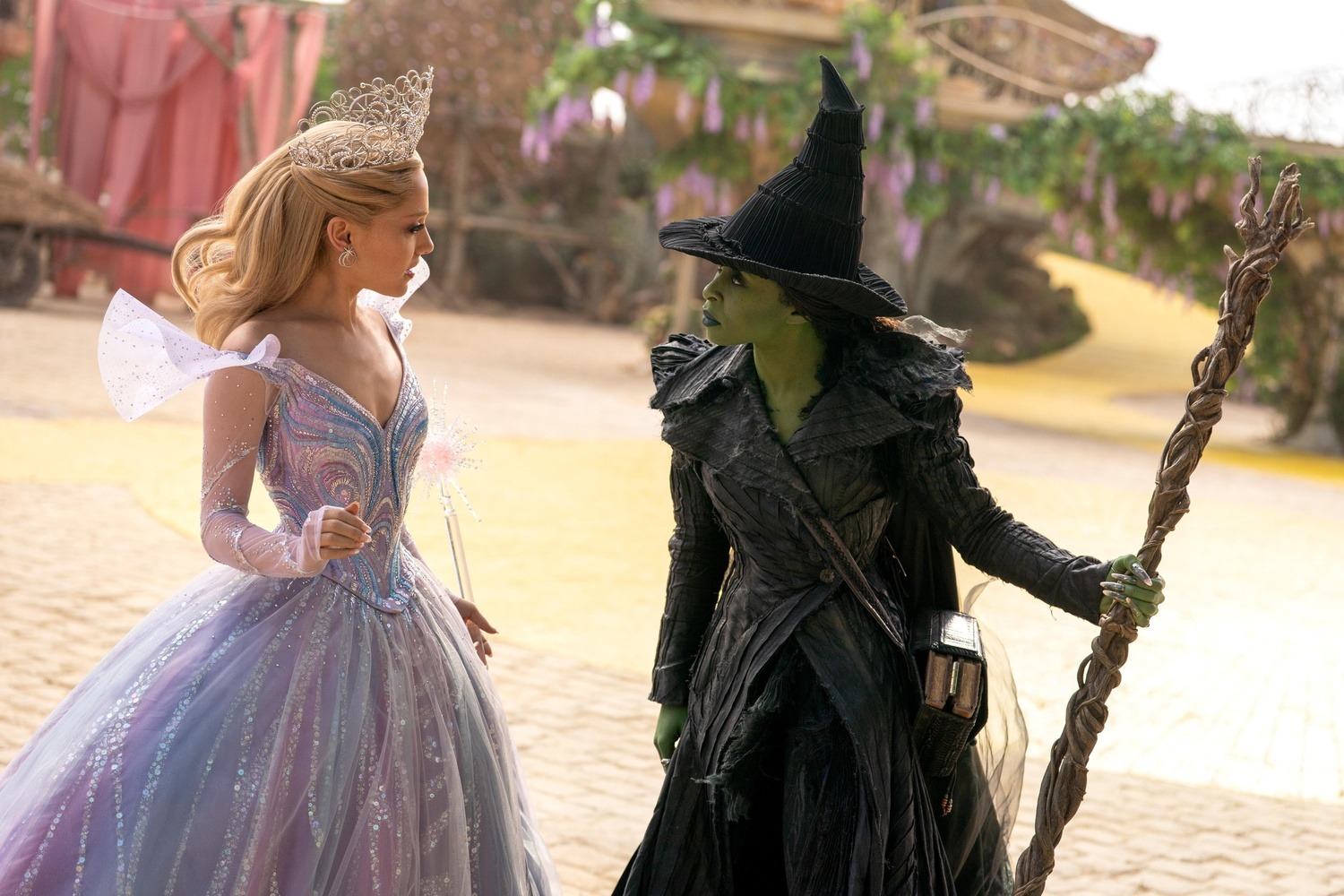
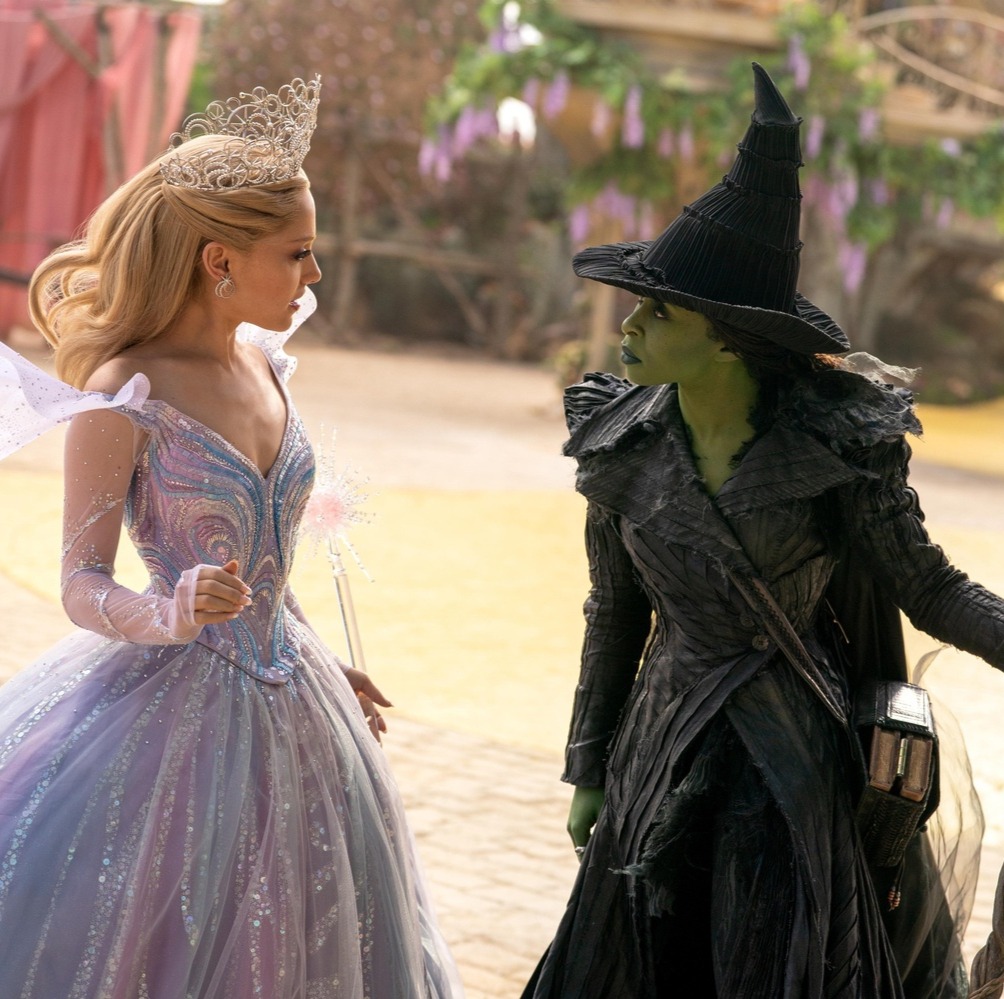
I’ll be honest right away. I’m not a fan of musicals and I probably never will be. I genuinely don’t see why we need to communicate anything through song. Just use words. Personal impressions aside, whether I like it or not, Wicked is destined to become a cult classic, and that’s simply a fact. We already realized last year that our world, or at least our For You pages, would be drenched in green and pink, and that even without watching a single minute of the film, we’d somehow know almost every song and reference. Wicked goes beyond the musical format and enters the realm of a cultural event, and you can’t tell me that clips of Ariana Grande and Cynthia Erivo aren’t haunting your social media feeds. Jon M. Chu’s direction is maximalist but precise, clearly designed for the era of short clips, fan edits, and endless quoting. This is a film that knows it will be taken apart piece by piece, and that it won’t lose its power in the process. Elphaba already exists beyond the film, as a symbol of the misunderstood “evil” woman, and Wicked gives her an emotional depth that audiences instinctively connect with. Glinda, on the other hand, remains just as charming and problematic, which only complicates the dynamic between them. As if their already strange off-screen relationship wasn’t enough. The reason Wicked will become a classic doesn’t lie in the music alone, but in its ability to seamlessly blend into the contemporary pop landscape. This is a film created primarily for the internet, in its aesthetics, makeup, costumes, and the language of its fandom, with cinemas serving as an added layer of experience. Even if you don’t like musicals, Wicked is impossible to ignore. And films that can’t be ignored, regardless of personal taste, almost always end up becoming cult classics.
Die My Love, Michael Morris
Cinema has always been fascinated by the figure of the suffering mother, and audiences are quick to recognize themselves in her. Die My Love has already provoked strong reactions and sharply divided viewers, and for good reason. It is an intense, emotional, and often deeply unsettling story about a young woman, Grace (Jennifer Lawrence), who, after moving from New York to a rural house in Montana and giving birth, begins to confront profound isolation and a rapidly deteriorating mental state. The film is an adaptation of Ariana Harwicz’s novel of the same name, and Ramsay employs a fragmented narrative and a raw visual style to present Grace’s experience without comfort, guidance, or neatly packaged explanations.
So why could Die My Love become a cult film? First, because it looks and feels unlike anything currently dominating mainstream cinema, which is genuinely rare. It is not a conventional drama, thriller, or psychological film, but a fusion of all three, paired with an uncompromising approach to mental health, motherhood, and identity. After its release, my TikTok feed was flooded with conversations, analyses, and fan theories about the film, driven by its unusual tone and powerful performances. And that’s precisely the point. It provokes intense emotional responses and leaves room for multiple interpretations, which is exactly what we tend to look for in cult films, isn’t it?
Sentimental Value, Joachim Trier
I truly don’t think it would have been possible to put this list together without Joachim Trier’s latest film. For those who may have forgotten it, there are others who remain completely obsessed, still talking about it and analyzing it months later. Once again, Trier returns to the territory he knows best: family relationships, unreliable memories, and emotions that are suppressed but never fully resolved. These themes feel especially present this year, something we can also observe across our regional film scene.
At the heart of the film are relationships between parents and children, between art and everyday life, between what has shaped us and what we would rather forget. One comment that keeps resurfacing across forums and Letterboxd reviews goes something like this: this isn’t a film you watch, it’s a film that quietly watches you while you think about your own parents. And we can probably agree that themes like these will never stop being relevant. In the end, Sentimental Value isn’t really about the past at all, but about how willing we are to live with its unfinished versions. That’s where its cult potential lies, because each of us carries at least one story that never truly received an ending.