A full rhapsody of citrus and floral notes could be felt on the skin, but one ingredient was missing. Alcohol. That evening in Split, the Yves Saint Laurent Beaute team introduced me to the new alcohol free edition of the Libre perfume, created by perfumers Anne Flipo and Carlos Benaïm. It was the first time I examined the concept of an alcohol free fragrance in such detail. The scent was intoxicating and delicate. It filled the entire room, and a few minutes later I noticed that the skin where I had applied it felt softer. As I uncovered the secrets of this new type of formulation, I wondered whether I was witnessing a perfume revolution.
Alcohol free perfumes as the gentlest fragrance trend
There are many reasons someone might reach for an alcohol free perfume. The alcohol free revolution has been simmering among young people for some time. Not only do they go out less often, but the same trend can be seen in their choice of drinks. Beverages such as kombucha, alcohol free beer and mocktails are emerging as the preferred options, signaling a shift away from alcohol.
Then it occurred to me that the skinification of other beauty categories has been shaping the beauty scene for quite a while, so it was only a matter of time before it reached perfume. However, perfumer Cécile Zarokian, whom I spoke to a few days later, reminded me of additional reasons why an alcohol free fragrance is an excellent choice
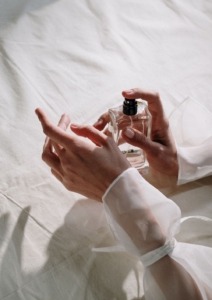
Photo: Cottonbro Studio
“There are several key reasons why alcohol free perfumes are becoming more popular. Some people have sensitive skin or simply want to avoid alcohol, which can dry out the skin. Water or oil based perfumes are often gentler and more suitable for direct contact with the skin”,
she explains, describing the increasingly common need for even the fragrance experience to come with a dose of care. Cécile also notes that certain cultural differences may answer my question. “In some cultures or religions, alcohol free products are preferred or even required, so brands offer these options to meet the needs of customers.” This type of formulation has been widespread for decades in Arab cultures, where pure perfume oils are much more commonly used. In hot climates, an oil based perfume functions far better than one based on alcohol. An oil based perfume evaporates more slowly, which can be desirable if you want the scent to last longer on the skin.
“Alcohol free perfumes are often preferred when spending time in the sun, because ethanol can increase the skin’s photosensitivity. Alcohol can temporarily compromise the skin’s protective barrier, making it more sensitive to UV induced irritation,” Cécile reminds me.
Fragrant emulsions last longer
Alcohol free perfumes are most often formulated as emulsions, meaning oil dissolved in water using special encapsulation technologies. This change affects how they behave on the skin, which is most evident in how this type of perfume projects. “Alcohol based perfumes evaporate quickly, which helps spread the scent, especially the top notes, but those notes also disappear more quickly. Oil based perfumes or emulsions evaporate more slowly, so they stay closer to the skin and last longer, especially the deeper notes,” Cécile says. And although longevity is not an issue for alcohol free perfumes, they do have one characteristic that may be a drawback for some fragrance enthusiasts.
A higher concentration of oil may help the perfume evaporate more slowly and last longer, but that slow evaporation results in a softer trail. “They do not have as strong a projection as alcohol based perfumes,” Cécile explains. Perfumes with especially strong projection can sometimes feel overwhelming, so the softer projection of alcohol free formulas may sound like the perfect balance that ensures longevity without burdening those around us.
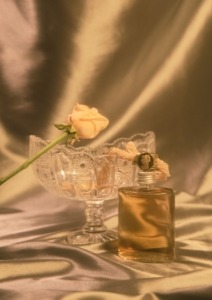
Photo: Eliza Alves
Notes that are harder to highlight in an alcohol free perfume
As we discussed longevity and notes, I wondered whether all ingredients work equally well in an alcohol free formulation. “Heavier, less volatile ingredients such as musks, woods, amber and some florals work well in oil based or emulsion perfumes. They are more stable in these systems and blend easily with oils. Lighter top notes, such as citrus and green notes, are harder to capture in alcohol free formulas because they evaporate quickly and struggle to remain stable in water without additional support, so they may lose intensity over time. This is where special emulsifiers and encapsulation technology come into play,” Cécile adds.
And although citrus and green notes can pose a challenge for perfumers, alcohol free fragrances like J’adore Parfum d’eau and YSL Beaute Libre L’eau Nue stand as true examples of how nourishing and long lasting perfume formulas with these challenging notes can be. We can also recall the rapid rise of independent brands that use oil instead of alcohol as their base, such as Orabella founded by Bella Hadid, which clearly shows that we are ready for something new. I do not think I will be the only one reaching for an alcohol free formula that nourishes the skin as it perfumes it. For fragrance enthusiasts seeking a new experience, there is probably no better way.