Exclusive for Vogue Adria, Marija Šević on youth, safety, and resistance
We spoke with artist Marija Šević, whose exhibition Youth is on view at the Novembar Gallery in Belgrade until October 12, about the importance of freedom, the inevitability of transience, and the current crisis in the local cultural and artistic scene.
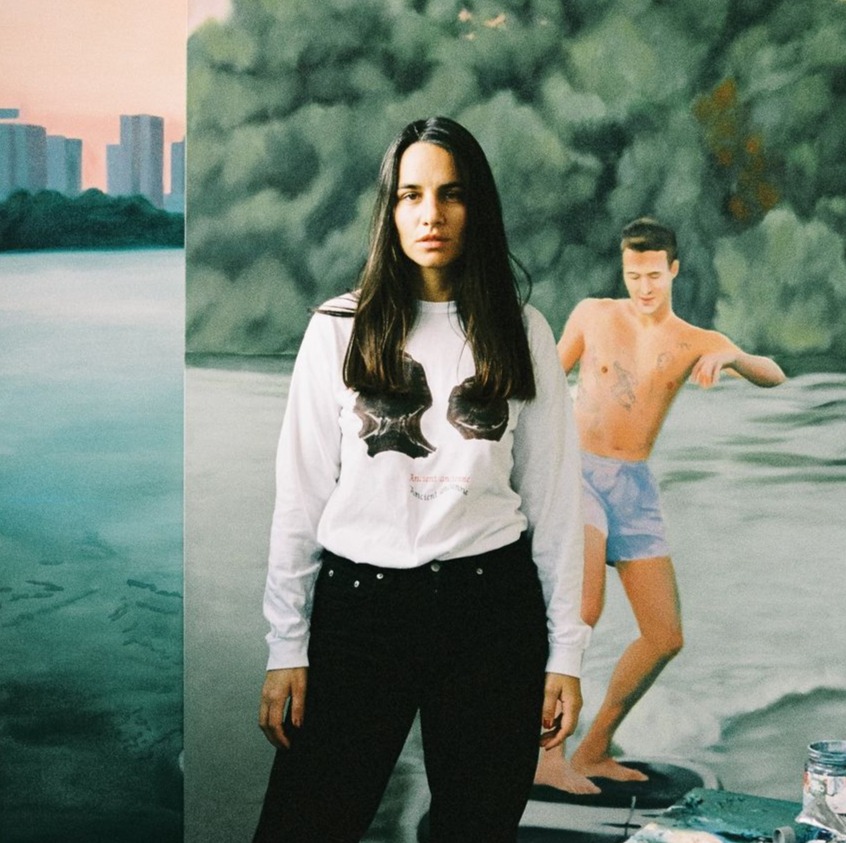
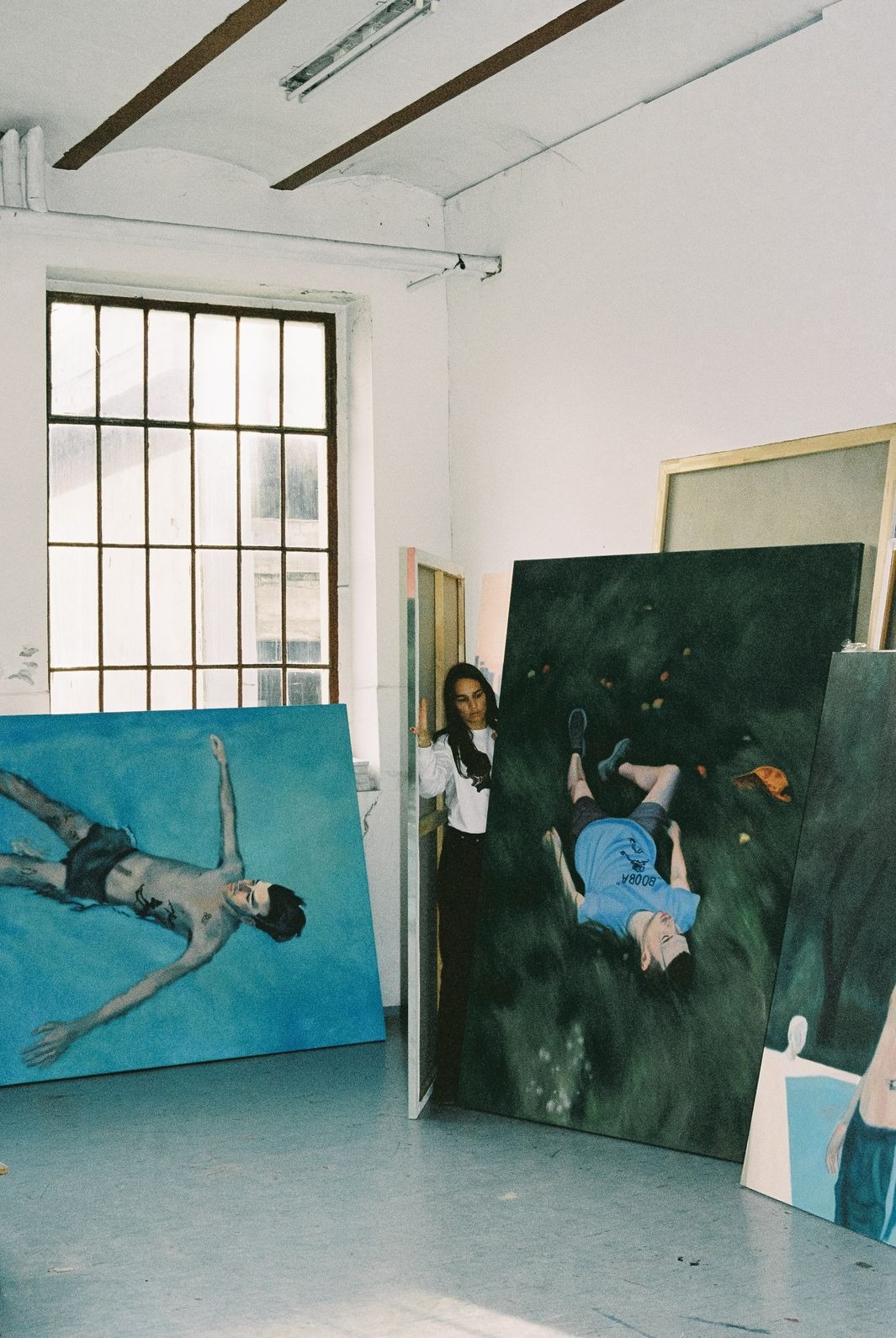
Would you like to live forever? Apart from being a great question for party games or for steering a casual conversation in a more serious direction, it is also a deeply philosophical one. We have all seen The Twilight Saga, right? Some of us more than once (me), and we all remember Edward in history class confidently talking about the Spanish War of 1918 because that was the year he actually died for the first time before being turned into a vampire and becoming forever “trapped” in the body of a teenager. Okay? Okay. Now that we are on the same page, we can agree that eternal life would be a brilliant idea if all our friends and family could stay young forever too. Youth sits at the heart of this question, and it is precisely why even Nietzsche, along with many before him, struggled with it. Youth is the greatest social advantage, the strongest driving force, the perfect excuse for the foolish things you do after a drink or two, but also a utopian phenomenon explored endlessly through literature, film, social media, and every corner touched by pop culture. Youth simply sells well. We want it in creams, workouts, ads, and fashion, but in the paintings of artist Marija Šević it appears in its most instinctive and honest forms. It is nothing more and nothing less than what it truly is. In Marija’s works we see youth frozen in a moment, forever promised, captured in a place that resembles Arcadia, a space where the intimate meets the collective and where a single moment becomes eternal.
On the occasion of her new exhibition titled Youth at the Novembar gallery in Belgrade, on view until October 12, we spoke with artist Marija Šević about inspiration, youth, and the sense of togetherness that runs through her paintings, as well as the lack of support for the cultural sector and the need for more working spaces.
The Youth series depicts young men in an isolated refuge on Great War Island. What drew you to this place and its symbolism?
Great War Island in Belgrade is a unique location, a nature reserve in the very heart of the city that, despite urban pressure, continues to exist as a sanctuary of remarkable biodiversity. It is home to many protected, rare, and endangered species of birds, animals, and plants. The natural complexity and fragility of this ecosystem felt deeply symbolic to me, as a parallel to youth itself, which is also a space of vitality, vulnerability, and transformation. This blend of wild nature and its uncertain future, contained within the borders of a protected yet endangered island, opened a space for thinking about youth as a temporary but crucial period of forming identity and freedom.
In your paintings, youth is portrayed as a state of mind, not only a biological stage of life. How would you describe this horizon of youth that you aim to convey through your canvases?
For me, youth is above all an inner state, a moment when we still look at the world openly, without fear, with trust and curiosity. This horizon of youth is a space of potential, uncertainty, and fearlessness, but also a place of deep emotions and vulnerability. In the works from the Youth series, I try to capture precisely that fleeting, almost untouchable moment when time slows down and sensations become more intense. I do not present youth as an idealized phase but as a complex experience that shapes us regardless of age. It is a state of spirit that can last and renew itself if we allow it space.
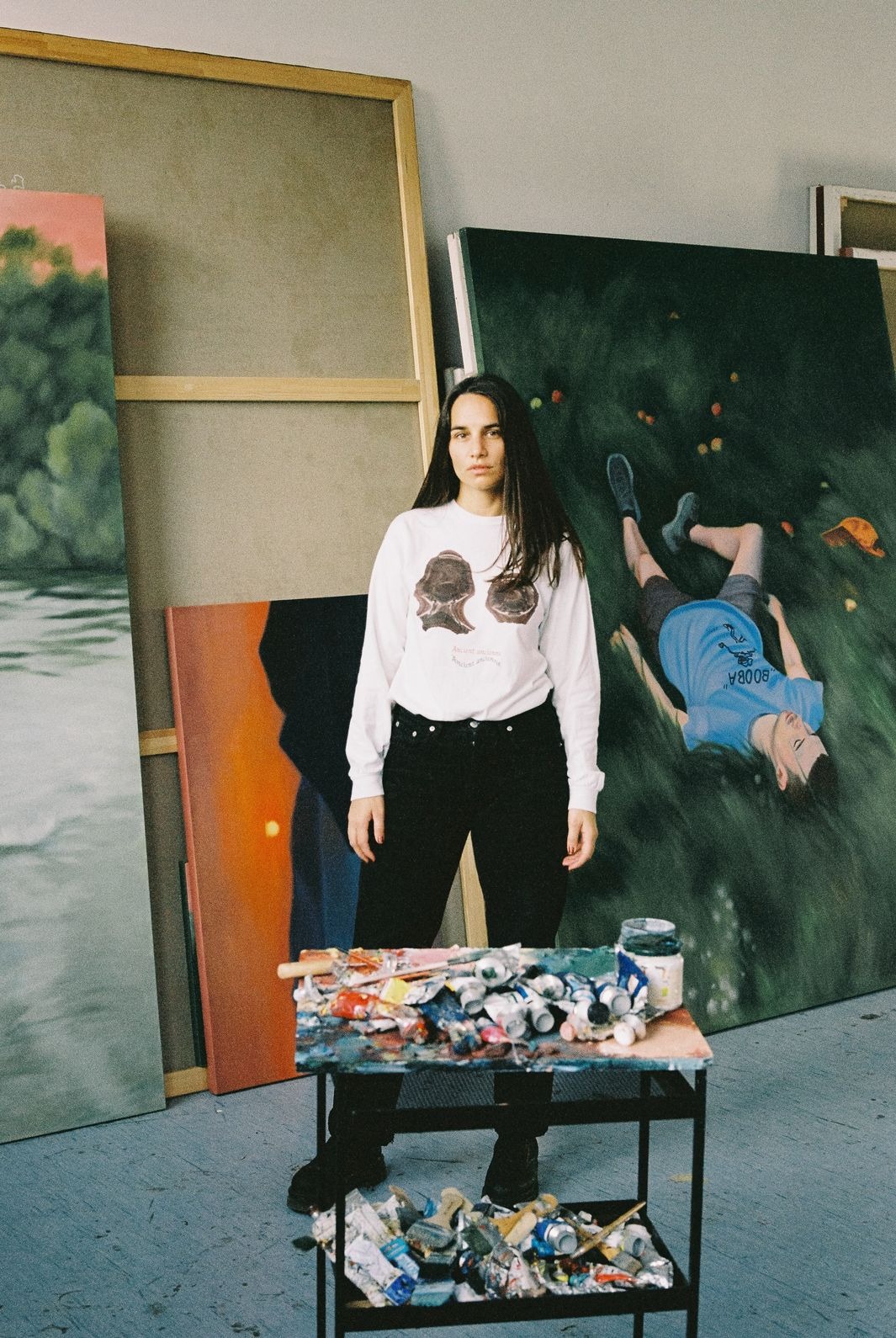
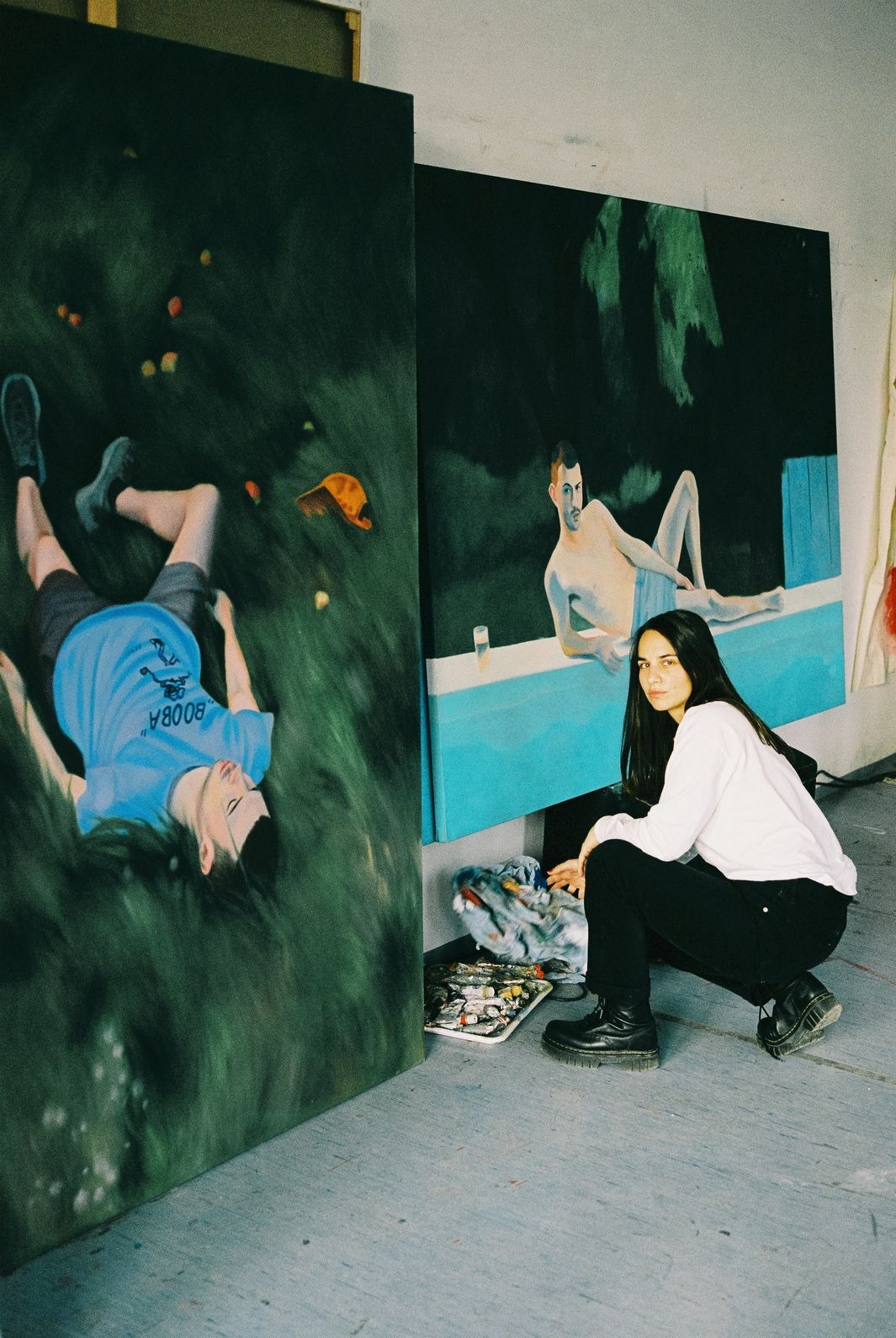
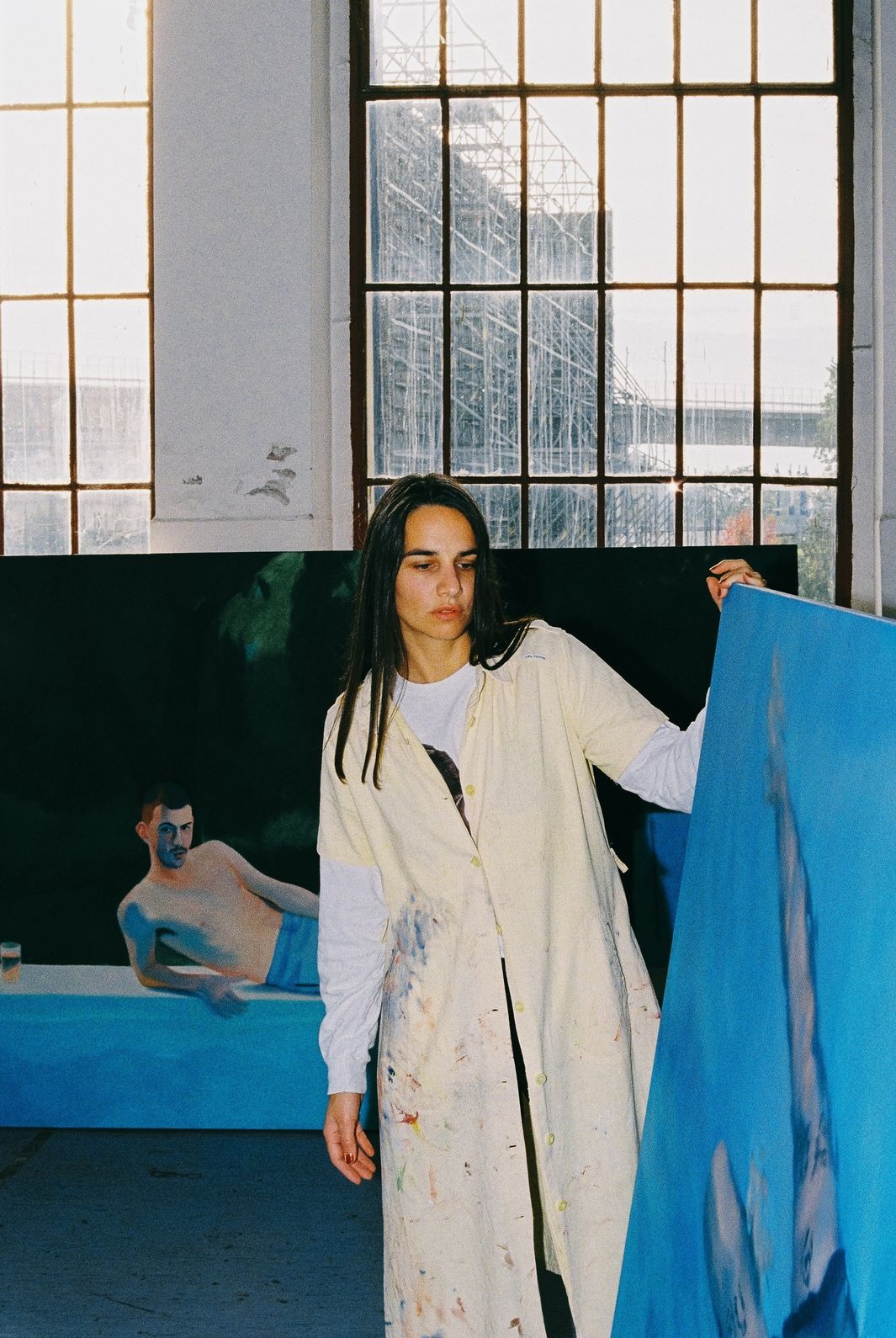
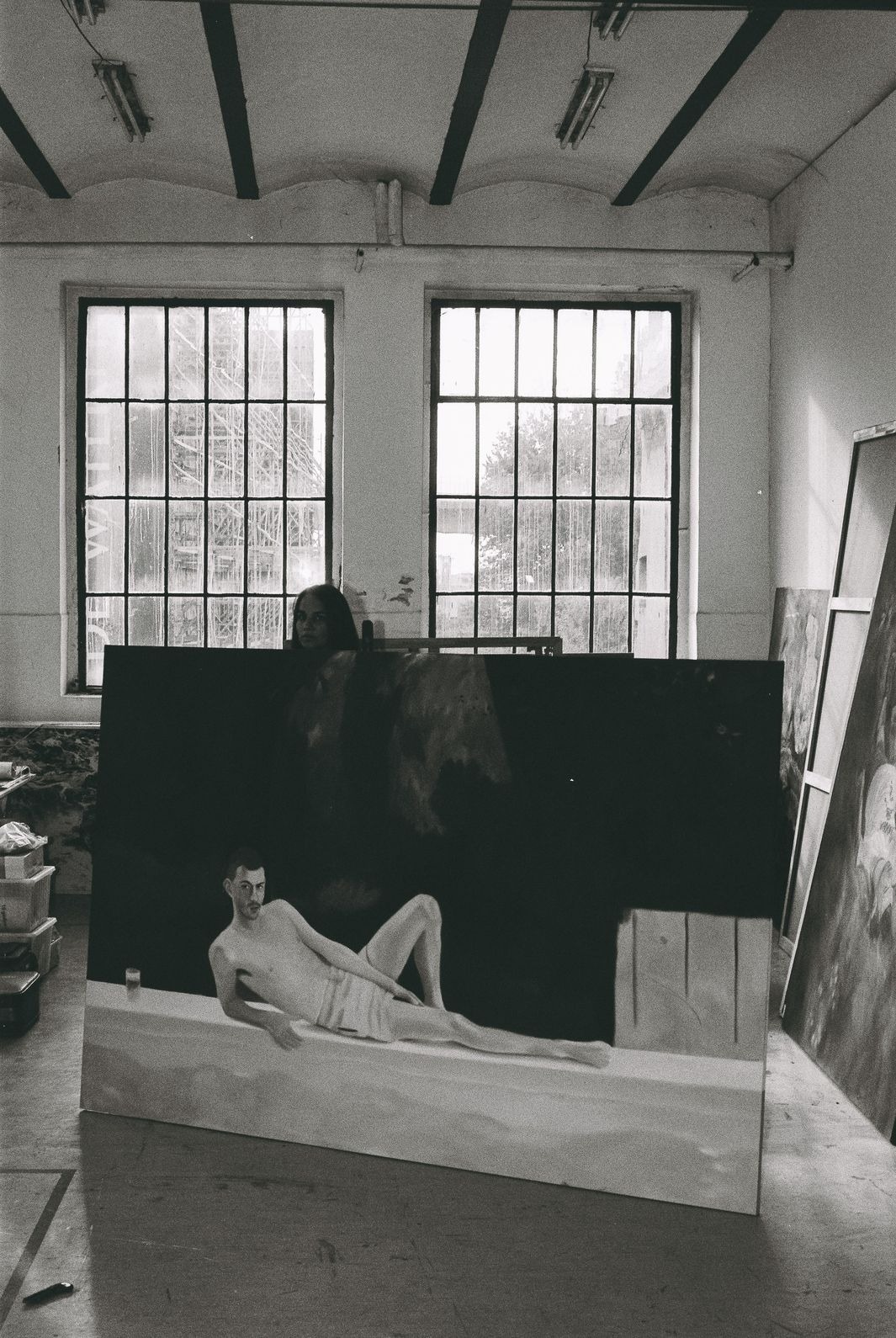
Marija Šević atelje
Transience and vulnerability are constant themes in Youth. Is the melancholy in these scenes, for you, a political or an emotional comment on contemporary society?
The melancholy in the Youth series is both an emotional and a political comment. Emotional, because youth by its nature carries an awareness of transience. It is a period that passes quickly but leaves deep marks. Melancholy appears as a reflection of this fleetingness, but also as an attempt to preserve the value of those experiences. Political, because in a society that denies young people the right to space, safety, education, and dignity, youth becomes an act of resistance. In the current sociopolitical context of Serbia, where students and young people are actively standing up against violence, injustice, and the collapse of institutions, the melancholy in these works carries the weight of helplessness, but also a quiet form of rebellion. It becomes a way to record and preserve what is being taken from us: the sense of freedom, belonging, and belief in change.
If you could extend the Youth series beyond the canvas in a single frame, what would happen next to these characters?
In the next frame, they are on the streets, where youth stops being a metaphor.
Your landscapes are more psychological than spatial, which was also the case with your paintings of the volcanic eruption in Iceland. How do you imagine the boundary between real and imaginary space in your work?
They are part of my personal experience and of an actual event, but by transferring them onto the canvas, they open a space for different interpretations, imagination, and emotional responses.
Your palette is soft, fluid, and pastel toned, which emphasizes the fleeting nature of the moment. How do you choose your tones and how do they communicate with the themes of youth and transience?
I try to make the tones and the atmosphere truthful. Would you believe me if I told you that this is exactly how it looked when I recorded those moments?
Although you paint portraits of real people, they become allegories. How do you balance the recognizable and the symbolic in your figures?
The protagonists in my paintings are real people, but through the process of painting they become universal carriers of an emotion or an idea. I balance the concrete and the symbolic by preserving the intimacy of the scene while opening it to different interpretations.
As one of the founders of the U10 space, you actively contribute to the local art community. How does the experience of collective work reflect on your personal artistic research, especially in the current crisis faced by the cultural sector?
Collective work within U10 has profoundly shaped my artistic approach. Through shared decision making, the exchange of ideas, and solidarity, I have learned how essential dialogue and support are for the survival of art, not only as a practice but as a community. In the current cultural crisis, this model of collaboration becomes even more important. I do not see it as an alternative but as a necessity.
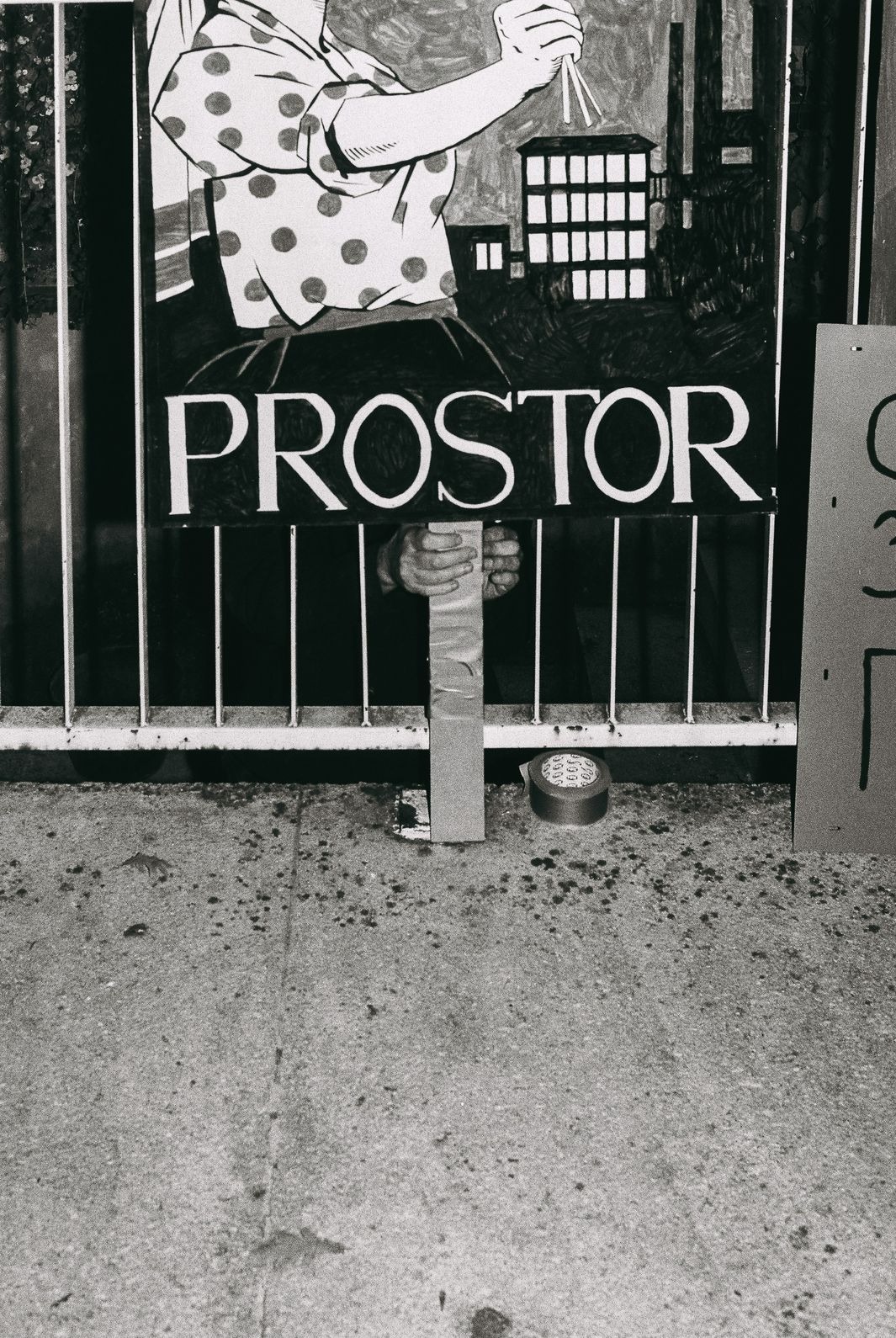
At the 60th October Salon you received a special award for the project Prostori za rad. What is currently happening with workspaces for artists?
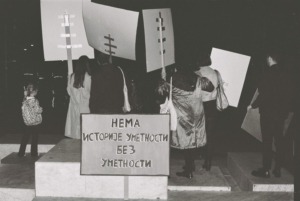
At the 60th October Salon, together with Lidija Dellić, Nina Ivanović, and Nemanja Nikolić, I received an award for the project Prostori za rad, which emerged as a direct response to the eviction of more than fifty artists from the Jugošped building in September 2024. The project brought an important institutional issue to light: the lack of regulated and accessible working spaces for artists in Belgrade. Despite numerous efforts and initiatives, the City has since failed to offer any space that artists, musicians, and cultural workers could use at subsidized rates.
Today we are left not only without places to work, but also without any official acknowledgment that artistic creation deserves systemic support. Workspaces are not a privilege, they are a basic condition for working in the cultural field.
If you had to describe Youth in one sentence to someone who has not seen the paintings, what would it be?
Youth is an ode to youth, freedom, and transience.